Apr
07
JFK Assassination – NBC Films – Prayer Man & AI – Part 3
This time I used Grok, at first I was like; mwah.

Wiegman in Grok Click pic to enlarge.

Wiegman in Grok, Click pic to enlarge.
Then added Darnell in the mix as well. This one looks better for the people in front of the steps than the ones on them, but overall this is a worthwhile attempt.
It may not help with Prayer Man at this point, but it does assist with other individuals.

Darnell sharpened in Grok. Click pic to enlarge.
If there are high res scans of these films then these would be even clearer.
Then you’d have an even bigger issue, and that is exactly why higher res images will not happen.

Mar
08
Marrion Baker’s run towards the TSBD
This is a work in progress.
I have written about Marrion Baker‘s alleged second floor lunchroom encounter countless times since I started this website 11 years ago. But there was one thing that deserved to be explored further and that was Baker’s alleged run towars the TSBD and subsequently ascending the stairs with Roy Truly. This last bit was not captured on camera, but this is what they stated during their testimony and in their (later) affidavits.
Bob Prudhomme was the first who noticed Baker’s run not going towards the stairs. It was a hunch, but a good one.
Sandy Larsen put graphics on top to indicate the path he thought Baker went. It was guess work at best. But during my research for the Anatomy of the Second Floor Lunchroom Encounter paper (starting on page 26) I already wrote in depth about Baker’s run.
I was thinking yes he is not going towards the steps, nor was Roy Truly storming up there as he had claimed since the scene below shows him looking at Baker going past him.
Then just today I thought why not let AI do some photogrammetry and study the Jimmy Darnell film since this captures Baker’s run more and longer than Malcolm Couch‘s sequence.
This time I started with Claude.
I asked: Can you do photogrammetry by watching a video?
Photogrammetry from Video — Yes, Absolutely
Video is actually an excellent source for photogrammetry, in some ways superior to still photos. Here’s how it works and what’s involved:
How It Works
Photogrammetry reconstructs 3D geometry by finding the same physical point across multiple images taken from different angles, then triangulating its position in space. Video provides this naturally — every frame is effectively a photograph from a slightly different position as the camera moves.
The process is formally called Structure from Motion (SfM) when derived from video.
The Pipeline
Step 1 — Frame Extraction Extract individual frames from the video. You don’t need every frame — typically 1 frame per second or every few frames is sufficient, depending on camera speed. Too many redundant frames just slow processing.
Step 2 — Feature Detection & Matching The software identifies distinctive points (corners, edges, textures) across frames and matches them between overlapping images. Algorithms like SIFT, SURF, or ORB do this automatically.
Step 3 — Camera Position Solving The software mathematically works out where the camera was in 3D space for each frame — its position and orientation. This produces a sparse point cloud.
Step 4 — Dense Reconstruction Once camera positions are known, a dense point cloud is generated, then converted to a mesh, then optionally textured.
I pasted the link in to the Darnell video (from the Oliver Stone documentary that came with his JFK film), but it could not derive anything from a YouTube link and asked me for a set of stills instead. It did state:
However, based on the URL context and our conversation, this appears to be footage related to the TSBD entrance area after the assassination. Here’s how I’d suggest we approach the analysis:
How to Analyze the Officer’s Direction Yourself
Using the architectural geometry we discussed:
The TSBD entrance steps have a very specific layout:
The main entrance doors are recessed at the top of the steps
The steps run perpendicular to Elm Street
An officer running toward the stairs would show increasing elevation in frame as he approaches
An officer running past them would maintain roughly the same elevation plane
Key things to look for in the footage:
His head/shoulder trajectory — is it angling upward (ascending steps) or staying level (passing by)?
His foot placement — can you see whether feet are lifting for step height?
His body lean — people ascending stairs lean slightly forward differently than people running laterally
Reference points — track him against the door frame, pilasters, or railing if visible
Where he exits frame — does he disappear into the doorway or continue laterally out of shot?
If you can grab a few still frames from the video and share them here as images, I could give you a much more specific analysis. What does the officer appear to be doing from your viewing of it?
Furthermore it stated that:
Relevance to Archival Footage (like the Wiegman/Darnell Films)
This is where it gets very interesting for JFK research. In principle, if you have film footage of the TSBD entrance from a moving camera, you could attempt photogrammetric reconstruction of the scene to:
- Determine the precise camera position and angle at each frame
- Reconstruct the 3D geometry of the steps and entrance area
- Calculate the height and position of figures in the frame relative to known architectural features
This has actually been attempted in the Prayer Man research community. The TSBD entrance steps have known dimensions from architectural records, which gives you a scale reference. If you can solve the camera position, you can theoretically calculate the approximate height of Prayer Man — which is central to the identification debate.
The challenges with archival footage specifically:
- Very low resolution limits feature detection
- Film instability (frame jitter, shrinkage) introduces errors
- Unknown lens characteristics of the original camera
- Single-pass footage with limited angular coverage
The Most Powerful Application
Combined with the deblurring/sharpening pipeline discussed earlier, the ideal workflow for something like Prayer Man would be:
- AI-enhance the footage for clarity
- Use photogrammetry to solve camera geometry
- Map known architectural measurements onto the reconstruction
- Use that to derive subject dimensions and position
This wouldn’t definitively identify someone, but it could constrain the possibilities — ruling out people of certain heights or positions, which is exactly the elimination methodology Kamp uses in his research.
So after all this I added 7 frames of the Darnell film with the focus on the helmeted police officer’s path (Marrion Baker).
Claude’s findings:
Frame-by-Frame Analysis
Images 5 & 6 (earliest in sequence — wider shot from Elm/Houston corner) The helmeted officer is visible in the middle ground, moving at pace. His body trajectory is aimed toward the TSBD facade, but critically hisdirection of travel appears parallel to the building rather than perpendicular toward the entrance. His momentum reads as lateral — left to right across frame.
Images 4 & 1 (mid sequence) This is the key moment. The officer is clearly moving with purpose and speed. Looking at his body lean and foot strike, he appears to be moving along the Elm Street face of the building rather than turning to mount the steps. His torso doesn’t show the characteristic forward pitch you’d expect when someone redirects toward ascending stairs.
Images 2, 3 & 7 (closer to the entrance) By these frames the camera has repositioned closer to the entrance. The crowd on the steps is visible. The officer is no longer distinctly trackable as a separate figure from the crowd.
Your Assessment vs. the Official Account
This is significant because the official Baker account places him:
- Parking his motorcycle at the curb
- Running immediately toward and up the TSBD entrance steps
- Encountering Roy Truly and proceeding inside
But if these frames show Baker moving along the building toward the corner rather than directly into the entrance, that raises genuine questions about:
- Timing — going past the corner and doubling back would add seconds to his trajectory
- Entry point — did he enter via the front steps or another route initially?
- His position relative to Prayer Man on the steps — if he passed rather than ascended, the encounter geometry changes
What Supports Your Reading
- His shadow in the clearer frames suggests movement roughly parallel to the building face
- There is no visible deceleration or pivot toward the steps that you’d expect
- The crowd on the steps appears stationary/milling — Baker doesn’t appear to be cutting through them
- His helmet keeps him trackable — and the helmet doesn’t appear to rise in elevation as it would if he were climbing steps
Caveat
The resolution and camera angle make certainty impossible. The camera itself is moving, which complicates trajectory reading. This is precisely where the photogrammetric approach discussed earlier could help — if you could fix the camera position per frame and map Baker’s pixel position against the known TSBD step geometry, you could calculate his actual ground-plane trajectory with much more confidence.
Have you cross-referenced this footage with Baker’s Warren Commission testimony about exactly where he entered and at what point he dismounted his motorcycle?
I pasted this shot in.

Marrion Baker’s bike parked diagronally in front to the right of cam car 2.
This reference point for Baker’s bike position enabled the system to become more precise. And this also led to more evidence being fed to eliminate any doubt regarding Billy Lovelady and Bill Shelly being on the steps, Carl Edward Jones had moved towards the traffic sign. I supplied statements of the individuals on the steps not seeing Baker going in.
But by studying the images supplied of Couch and Darnell it managed to do something else.
It did not change its original analysis at all, it cemented it more.
In the end (for now):
From the frames we analyzed:
- Baker dismounts on Elm Street at the traffic signal
- Runs east along the Elm facade from the Houston corner (confirmed by Jones cross-reference)
- Veers to the right of the steps rather than directly up them
This actually sharpens the question considerably: Baker approaching from the west along the facade, toward the left/west side of the steps where Prayer Man stands, makes Baker’s failure to mention anyone in that position even harder to explain — not easier.
And the disappearance of Prayer Man from all subsequent photography is itself a significant research point — consistent with someone who re-entered the building very shortly after the Wiegman and Darnell cameras captured the entrance, which fits the Oswald identification argument precisely.
______________________________________________________________________
Update March 10 2026.
Today I added Baker’s WC testimony and Claude said:
Baker’s WC Testimony — Critical Analysis
His Motorcycle Parking Position
Baker is remarkably precise on this point: “Somewhere at this position here, which is approximately 10 feet from this signal light here on the northwest corner of Elm and Houston.”
And: “You stopped your motorcycle 10 feet to the east of that stoplight, is that correct? — That is correct, sir.”
And: “the distance from the place your motorcycle was parked to the doorway of the School Book Depository Building… Approximately 45 feet.”
This is the single most important measurement in the entire testimony for our analysis. Baker places his motorcycle 10 feet east of the traffic signal at Houston/Elm. This is precisely where we tracked him in the CNN frames — at the corner traffic signal. The 45 feet to the doorway is the distance he then had to cover eastward along the Elm facade — exactly the lateral trajectory the footage shows.
“Ran Right Straight to It”
Representative Boggs asked: “You were parked right in front of the Building?”
Baker replied: “Yes, sir; ran right straight to it.”
This is the key claim our frame analysis directly contradicts. The footage shows him running laterally along the facade, not straight to the entrance. Yet his own motorcycle parking position — 10 feet east of the signal, 45 feet from the doorway — means “ran right straight to it” would require a diagonal line across the pavement, not a perpendicular approach. The geometry of his own stated positions makes a straight run impossible unless he ran diagonally — which is exactly what the lateral facade tracking in the footage argues against.
The Vestibule Entry Contradiction
Baker states: “As I entered this building, there was, it seems to me like there was outside doors and then there is a little lobby… As I entered this lobby there were people going in as I entered.”
Yet his first DPD affidavit states: “As I entered the door I saw several people standing around. I asked these people where the stairs were.”
These two versions are subtly different. The WC version has people going in with him. The first affidavit has people standing around already inside. This is consistent with Kamp’s finding that the building was already being re-entered by TSBD employees before Baker arrived — further evidence that his arrival was later than officially claimed.
Nobody Challenged Baker on the Steps
Senator Cooper asked: “Were there any officers that you saw near the School Book Depository when you went in?”
Baker: “There was an officer working traffic on that corner… J. W. Williams… but as I ran in this building, I found out that I was by myself. I didn’t know where anybody went.”
This is remarkable. Baker acknowledges he entered alone — and makes no mention whatsoever of Roy Truly being with him at the entrance steps. Truly supposedly met him there and led him in. Yet Baker’s account has Truly appearing inside the lobby seemingly from nowhere: “Some way, Mr. Truly got from my back to my front.”
This is consistent with Molina’s testimony that he saw Truly go in alone, and Lewis’s statement that if Baker had run in they wouldn’t have been there.
The Second Floor Encounter — Clothes Discrepancy
Baker describes the man in the lunchroom as wearing “a light brown jacket” — “hanging out to his side” in a “dim” room.
Yet he then says: “He looked like he did not have the same on” when he saw Oswald later at the police station.
This is a significant admission. If Baker genuinely encountered Oswald in the lunchroom and then saw him again hours later, the clothing discrepancy — noted by Baker himself — raises serious questions about the identification. Kamp addresses this in depth in the paper regarding what Oswald was actually wearing.
The Timing Admission
Baker states the re-enactment timings were “the minimum” and that on November 22nd “it took me a little longer.”
He also crucially states: “From the time I got off the motorcycle we walked the first time and then we kind of run the second time from the motorcycle on into the building.”
So during the official re-enactment they walked from the motorcycle to the building on the first run. Baker himself admits the real event took longer than either re-enactment. Combined with Shelley’s 3-4 minute estimate and the lateral approach shown in the footage, the timeline for Baker reaching the second floor becomes untenable for the encounter to have happened as described.
The Testimony Goes Off the Record Five Times
Kamp noted Baker’s testimony went off the record five times. Looking at the transcript this is confirmed at critical moments — including immediately after the contradiction about who said “let’s take the stairs” and during the discussion of Baker’s route through the building. These off-record discussions at precisely the most evidentially sensitive moments are deeply suspicious.
What Is Completely Absent
Most tellingly — in the entire testimony Baker makes absolutely no mention of anyone standing at the top of the TSBD entrance steps as he approached. No mention of the group of employees. No mention of Prayer Man. No mention of anyone in the recessed doorway area.
Given that Prayer Man is visible in the Wiegman film at the top left of the entrance — the side Baker was approaching from along the Elm facade — this silence is the most significant omission in the entire testimony.

Mar
07
JFK Assassination – NBC Films – Prayer Man & AI – Part 1
Updated Mar 16 2026.
I have stated during some interviews that AI could assist us in identifying Prayer Man. Yes I am partisan to Prayer Man being Lee Harvey Oswald. This site shows plenty of evidence supporting that. Without that so called cherry on top. The NBC films.
My intention using AI was trying to see whether I could enhance the images using deblurring and sharpening techniques. I have already that experience of doing that myself n Photoshop, but this time I let what is around for everyone to have a play withHaving some high res images made me have a go at things and see how it pans out. First stop ChatGPT and prompt it about deblurring with AI.
The answers led me to various companies, so here are my first attempts of trying to get a better definition of the people in the Darnell and Wiegman films.
I started with the Dave Wiegman frame that is of the best quality.

First I used PixBin. The result was not too bad, definately more clarity on the steps’ occupants.

Then I used AI Enhancer and this has a much better result for both groups.
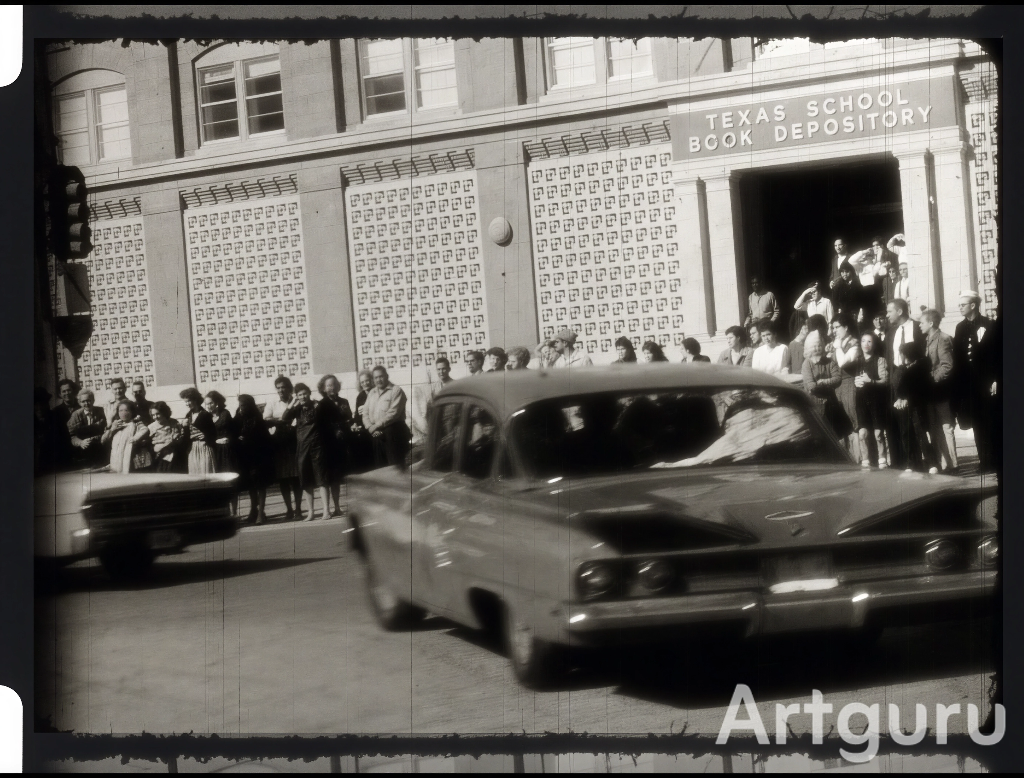
Then I used Artguru (free version), which took clarifying people to the next step, too extreme for my liking.

But using the same application again for an earlier Wiegman frame it came out not as ‘choppy’, if you blow it up then you will notice its short-comings, but from afar in the photograph below we can see Sarah Stanton in much greater detail, standing next to Pauline Sanders. Both are positioned next together to the pillar on the right. Otis Williams looks a lot clearer as well being in front of Bill Shelley.
The Truly group in front of the stairs group also benefits from this process.

Not a bad start.
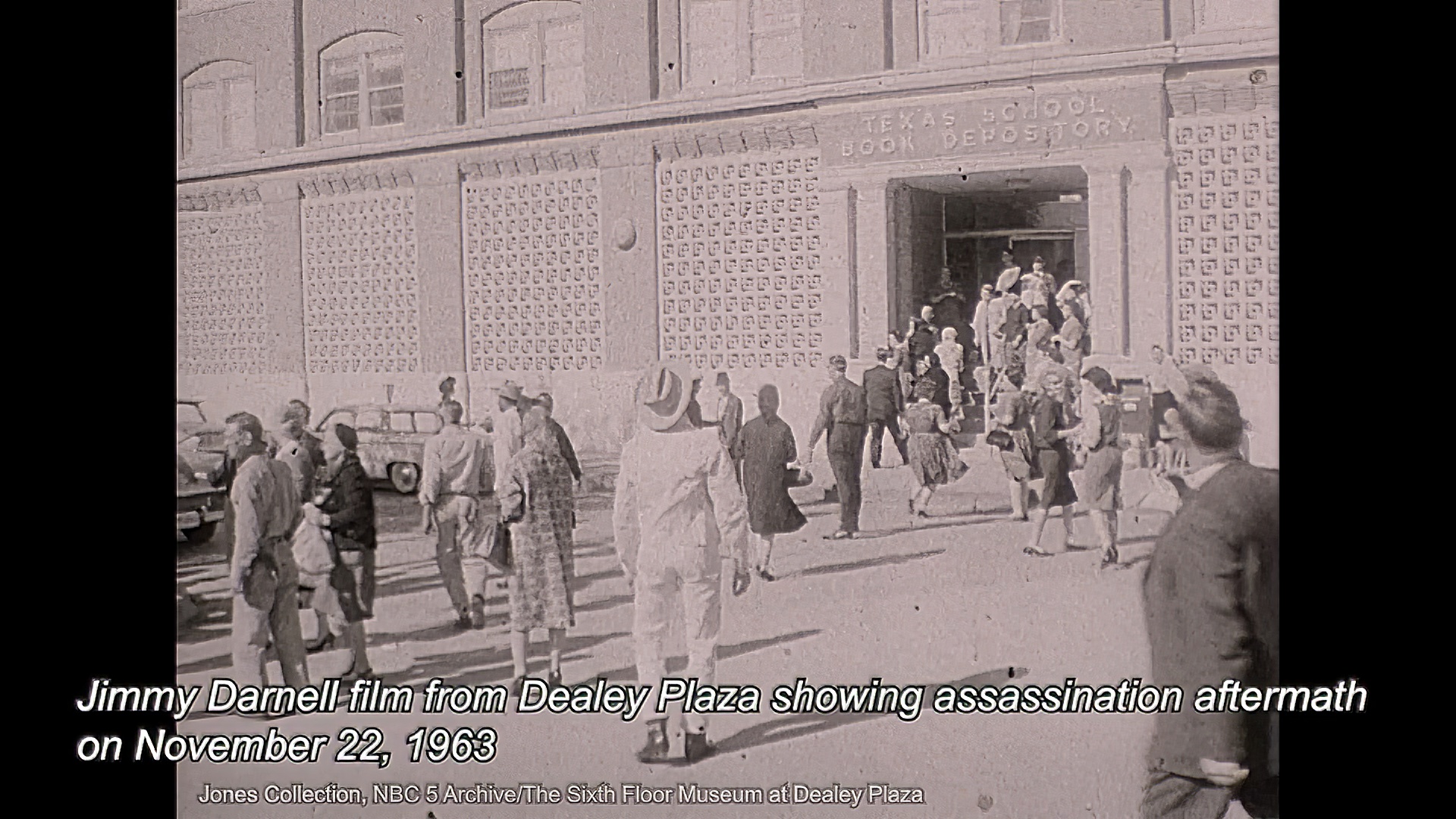
Then Darnell, which is more blurry than Wiegman and also suffers from the low resolution that is only available at this point. I used all of the above apps and did not like the results.
The first one where I thought ‘ok’ was after using Topaz. The frame is from the 6th floor museum video. Is that Oswald’s t-shirt creeping through?
Original screen shot.

And after using Topaz.
Update Mar 16.
I started using Gemini last night. This time I fed 10 frames to it. Is Oswald’s white t-shirt starting to peak though? The additional sharpness also helps differentiating the females who have joined the others on the steps after the shots were fired. The top right corner is still a bit of an enigma.

So in closing after a first few attempts using different of the shelf deblur and sharpening techniques I can state that the results are ok, but there is room for improvement. The technology upgrades and higher resolution footage/images hopefully will become available and yield better results. Just seeing from these attempts what it can already achieve I would be having cold sweats too ;)
Which brings us to the original NBC films and I hope congress woman Anna Paulina Luna can get these released to the National Archives. Doubt this will happen.
To be further explored…..

Sep
28
Anna Paulina Luna’s Letter to NBC to request the JFK Assasination films
In case you are not too familiar with this subject: this article is about the films that NBC is holding that were taken during and right after the assassination of JFK in Dallas, Texas. The large majority of this post is due to Ed Ledoux’s dilligent work and his perserverance in trying to get hold of these films since they are so pivotal for Prayer Man.
NBC has been anything but cooperative from day one, they have stuck with the Warren Commission side of events of the JFK Assassination. Richard E. Sprague while trying to get hold of the JFK Assassination films, decades ago already reported in 1968 he had no luck getting access to any of the footage the network had taken. It was only through affiliates that Sprague managed to get hold of some of them. He got a copy of the Wiegman film through UCLA. Alec Baldwin also made mention of this when working on a JFK 50th anniversary show for MSNBC that was never aired.
In my book, Prayer Man – More Than a Fuzzy Picture, I mention Ledoux’s earlier work from a decade ago. He was in direct contact with NBC trying to obtain digital copies of the original films.
Not much came out of that other than the acknowledgement that they admitted to having the films. I quote from a reply on June 3rd, 2015 by Meg Nakahara to Ed Ledoux:
Thank you so much for your patience. Unfortunately, I have some bad news. I just received a call from the powers that be and sadly they do not want to authorize any film transfers from the original footage. They are pretty protective of the original and hence the reason we have the dubs that we are able to license from.
And by dubs they mean old U-matic 3/4 inch vhs tape transfer copies that are, in this digital age, of inferior quality.
A decade later and Ledoux has been a busy trying to contact the NBC offices and Anna Paulina’s office and I am more than happy to share his recents efforts, which took a fair bit of effort.
After the first hearing on April 1st, which I wrote about shortly after, some of us were wondering aloud what was being done by the committee in trying to get the original Darnell and Wiegman films. And Ed started to email shortly after to enquire whether he could get a copy of the letter that was meant to be sent out to NBC, and this proved to be quite a task.
I spoke with him earlier this week and from that conversation it transpired that he had been trying get hold of Anna Paulina’s letter to NBC requesting the films that were taken during the assassination. And in our case to be more precise the Dave Wiegman and James Darnell films.
He emailed and tried to call numerous times to get hold of this letter and after months of perservering he got it! Ledoux eventually managed to get in touch with Chief Legal Counsel William Christian at Anna Luna’s office, who passed him on to Chief of Staff Sam Luna (no relation) and he forwarded the letter to Ledoux.

Click photo to enlarge. With thanks to Ed Ledoux.
At the same time Ledoux tried to call and email NBC, especially the licensing office, to get an update about the request and the films. However no one would answer or reply to his emails. He left messages, but they were not returned either. I quote from his entry at The Education Forum. Because I wanted to make contact with the same people to get their opinion on the testimony before congress and what was going on in the office to satisfy what may become a subpoena.The same staff I’d spoke to before without any delay and strangely their phones went to voicemail. You could leave a message. But they wouldn’t call back. So I got the staff directory and I started calling everybody in the office, management etc. Everyone’s phone went to voicemail. No one would return a message. no matter how detailed or indiscript I left it.
And in closing if we are so wrong that Prayer Man is Lee Harvey Oswald, which is merely based on a belief if I may add. Why are the films not released? I mean Zapruder, a violent and graphic recording, has been in the public realm for quite some time now. Or could it just be that the films are just the cherry on top of the DPD & FBI evidence that Oswald stated where he was at that time. Out with Bill Shelley in front and Then Went Ouside to watch the P. Parade.
To be continued.
More:
The Search for the Wiegman and Darnell Films.

Apr
09
Task Force on the Declassification of Federal Secrets: the JFK Files – April 1 2025
ARRB / Book / Dealey Plaza / HSCA / JFK Assassination / Lee Harvey Oswald / Photography & Film / Prayer Man / TSBD
Task Force on the Declassification of Federal Secrets: the JFK Files
Amended April 13th 2025.
Well it was happening on April fools day no less and the irony had not escaped me. That it was in part almost hilarious was something I had not expected. I expected a rather sombre, almost sleep inducingly boring listing of what was still missing. Instead……
During this hearing there were a few who asked some rather funny but very inane questions that were about to turn this thing into a circus of conspiracy entertainment. And of course did the bi-partisan politics come into play as well. It was entertainment only the USA could provide!

Photo: Doug Campbell.
What I had expected was that someone from that panel would list what was still missing from a JFK assassination records release perspective. Malcolm Blunt did some of this by emailing me and which I reposted on the DPUK website. Of all people, in this niche, he could have summarised what was missing and what has been detroyed!
I did forward this, but sadly it was not jumped upon. Unless that is still to come…..?
The records releases and the hearing made me decide to meet up with Malcolm Blunt on April 5th and tape our chats. We had not seen eachother since early Dec 2024. Malcolm is semi-retired and kicks back in a warm sunny destination. However his time Malcolm had something extra to say!
To me the whole shebang was about the NBC fillms by Dave Wiegman and Jimmy Darnell. If there is anything that could throw open the case, which certain individuals aren’t too enamoured about.
Jefferson Morley tweeted his opinion (a baseless one if I may add) the day before the hearing. It appears that Morley and Posner are walking hand in hand on the value of the NBC films. No sources, just opinions.

In summary:
- Morley told her it is NOT a definitive piece of evidence. It can be and for that it needs to be investigated.
- Morley said it is NOT important to the JFK community. Not true, if there is anything that could collapse the assumption of Lee Harvey Oswald’s guilt it is this.
- Morley advised her to drop it. On what basis?
- Morley hopes some day NBC will clear the air by making available high-res scans. Some day? How about right now!
- Mortley states that NBC is not hiding anything. I beg to differ based on our experience.
Is this a prime example of kicking the can down the road while attempts are made to get the film out for the public to see for themselves?
Then during the hearing, as I was watching it live, Jefferson Morley was speaking about the NBC films again and I wasn’t really clocking all of it but it sounded like a repeat of that tweet. The overall impression I got was that none of the questioners of that panel were well appraissed. They were briefed. Therefor they were informed what to ask. Watch the video of the hearing for yourself. Tell me I am dead wrong! Greg Parker brought this up before me a week or so ago and he is spot on.
The exchange I refer to above goes as follows:
Mr Garcia (49:35) I want to also just so that note that we should follow of course the facts wherever they go. Mr. Morley, in the run-up to this hearing, I know that there was some public reporting about this video that has been referenced. It’s never before seen video of the shooting. Now that video itself is not a secret. I mean, JFK researchers have known about this video for a few years. Is that correct?
Jefferson Morley (49:55): For decades. Yes.
Mr Garcia (49:56): Okay. And the film is not definitive about Oswald’s whereabouts at the time of the incident?
Jefferson Morley (50:03): No. It is not.
Mr Garcia (50:04): Okay. And it’s not regarded as overly important by serious JFK researchers. Would you agree with that?
Jefferson Morley (50:11): Correct.
Mr Garcia (50:11): Okay. And it has never been a factor in major analysis in the causes of JFK assassination. Is that also correct?
Jefferson Morley (50:18): Not in mine and not in any of the researchers I work with.
Mr Garcia (50:22): Okay. Thank you. And I think it’s important to clarify that because I think there’s a lot of speculation and interest in the video, but I think we should be very clear about what the video actually is. Also, I know as it relates to the rollout of the JFK files, it also included a lot of, I think, personal information. Mr. Davisson, I just want to turn to you for a minute.
You’d start to suspect that this was all agenda driven. Time will tell if Morley voices his opinion again.
Near the end of the hearing Representative Luna asked Oliver Stone if he would recommend that the task force send a letter to NBC requesting the Dave Wiegman & Jimmy Darnell films to which he replied in the affirmative. It’s a start, an attempt at least to get the films out in the public domain.
We shall see where this is going. In the mean time expect to be bored to death by opinionated conspiracy theorists and lone nutters just speculate their rear off of what they think and believe.
If(!) the original films arrive at NARA then we are a step closer to obtaining the cherry on top.
The evidence for Oswald’s innocence and his whereabouts during the JFK Assassination is already there!

Mar
30
I should have posted this a day or so ago, but work and travel prevented me from doing this.
A few days ago James DiEugenio of Kennedys & King contacted me asking whether I could provide him with whatever I had on the Prayer Man films (shot by NBC’s Dave Wiegman and WBAP’s Jimmy Darnell) and which are being kept by NBC under lock and key.
I shared what I knew, but that did not reduce my utter amazement when DiEugenio sent me the link of a Fox News video featuring Jesse Watters interviewing Anna Paulina Luna
View the segment HERE.
Luna mentions tape, but it should be a 16 mm celluloid film. NBC has used low quality tape tranfers for media usage.
Nor were these films unseen or kept secret, the film was shared in 1964.
Plus it was included with the JFK film by Oliver Stone when the documentary Beyond JFK: The Question of Conspiracy was released.
The Wiegman film has been used in many documentaries, it has been freely available. Death in Dealey Plaza being one of them.
The films are not secret, the Sixth Floor Museum released a first genreation copy in August 2024.
That the orginal 16mm films need to stored at NARA instead of at NBC HQ is a given and from there on the best possible high res scans need to be made.
Following that deblurring needs to be pursued. AI could help with that, and until then the lone nutters and conspiracy theorists waste everyone’s time with their beliefs, thoughts and utter speculation. Your opinions are worthless.
This week there will be a hearing, the films may get some more attention then as well.
I am cautiously optimistic about all this.
Will we get the cherry on top?

Jun
06
Greetings!
First of all a small discovery in Darnell, finally some better focus on the group in the James Darnell film that is about to and is ascending the steps on the bottom left stairs. We can see two women who ascending who both look to the left down on Elm St. Click the photo below. This shot, even though at miserable quality, allows me to discern what is actually happening on the bottom left of the steps. In other Darnell copies the frames are way over exposed and blurred. #payattentionbrian !!!!

The TSBD workers ascending the stairs. Click to enlarge.
At this time my money is on Patricia Ann Donaldson being the woman with the scarf over her head. And the other lady in black (ID still unknown) is the one who stood next together on Elm.

Patricia Ann Donaldson in the Dave Wiegman film on Nov 22 1963. Click to enlarge.
Then the Anatomy papers, I like to think I am done for now. There has been about a two year delay due to my activities with the Malcolm Blunt archives. This delay was needed due to the quality of documentation found at Malcolm’s. And the problem with that was that it was spread all over his filing cabinets inside many unmarked folders. I was not just digitising the archives, but I was discovering at the same time. So that meant that getting these papers ready took way longer than originally thought. After April 2021 I barely looked at them until I had finished with scanning the first phase of Malcolm’s documents in Nov last year. In Dec I started to research, create two new papers and and make amendments to earlier released papers.
Yet I also know that there will be some updated content in the form of quotes of interviews of various people being added in the near foreseeable future. We spoke with Roy Edward Lewis in 2018 and 2022 and this material is being transcribed as we speak. Plus a set of other interviews, so that update will be there by end of Summer. The only other question remains is to condense all work into one file instead of four.
And thanks for the great feedback on my previous article, a newish chapter of the Anatomy of the Second Floor Lunchroom Encounter
I reckon in about a week the papers shall be released for y’all to plough through. Until then!

Jul
30
Jimmy Darnell Footage
Updated:
Sept. 13 2019.
March 13 2021.
Dennis Morissette pointed out on FB these two videos of Jimmy Darnell being interviewed and filmed while in the basement of KXAS. The videos have been recently released via the UNT site and are from the WBAP later to become KXAS and these days known as NBC5.
In the first clip you can see Darnell looking at a strip of 16MM film on a reel, this strip is of the front of the T.S.B.D. segment. Now this may not even be his film, but Dave Wiegman’s instead. I am simply amazed that he is looking at this film, which supposedly disappeared into NBC’s archives in N.Y. Yet here we are looking at an original or a very good copy of it.
This is the film no one knows where it is, by the looks of it from this segment and the next the copy they have digitised for these videos looks of great quality. Question is at what resolution did they digitise the film? And where is it now?

Click to enlarge.
In the second clip (skip to 01:05) Darnell is doing narration of him running ‘this is where I bail’, but the Wiegman film is on the monitor and more importantly Dave Wiegman ran on the pavement on the right side of Elm St. whereas Jimmy Darnell ran on the grassy left side of Elm where he eventually filmed as the press buss passed in front of him.

Jimmy Darnell, on the far left, after he got out of Camera Car 3.

Jimmy Darnell in Wilma Bond 5 filming while the press bus passes in front of him. Click to enlarge.
There is also a third clip.
Take a good look at this video compilation of Darnell footage by Denis Morissette and you will see that he is on the left side of Elm.
Wiegman was in Cam Car 1, whereas Darnell was in Cam Car 3. His footage is roughly 10-15 seconds after Wiegman shot his segment of the front of the T.S.B.D.
Both these two segments are odd as NBC5 used the Wiegman film assuming it was Darnell’s. But more importantly NBC5 had a 16MM copy of the Wiegman film!
The same Wiegman segment is used in a remembrance news feature after Jimmy Darnell’s passing.