

Nov
10
John Abt representing Lee Oswald

John Abt
In my paper Anatomy Of Lee Harvey Oswald’s Interrogations the name John Abt pops up quite a few times. Some people, like Will Fritz, said Oswald wanted Abt to represent him on Friday. This was rubbish as I already shown in that paper that the record stated Oswald made his very first two phone calls in the early afternoon of the 23rd (pages 225 & 226 from the PDF linked to above), almost 24 hours after being dragged in after his arrest in the Texas Theatre. One of those calls was an attempt to call New York. That by itself is a good indicator that Oswald wanted to contact Abt on the 23rd.
In the pages below (thanks to Malcolm Blunt) Abt tells of a CBS reporter contacting him on Saturday morning that Oswald wanted Abt to represent him and unless Oswald himself would make that request not much was going to happen.
Click the images to enlarge them.

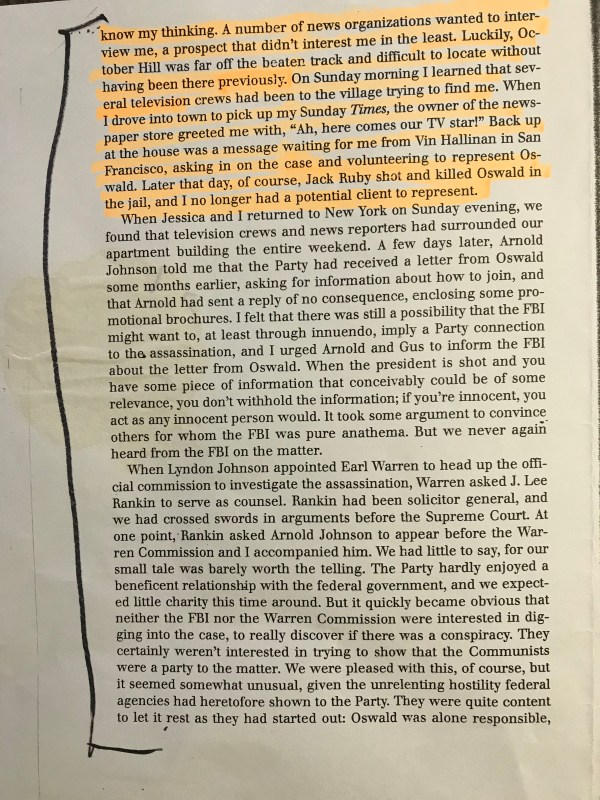

Then there is a video segment (starting at 5:25, on the third floor of Dallas City Hall, it shows Oswald being escorted through the corridor on his way from Fritz’s office to the jail elevator.
It is shot on Nov 23rd after Oswald’s first interrogation roughly at 11:30, he is in his white t-shirt only and then stops just before entering the door to the jail elevator and being pulled in by the D.P.D. detectives. But Oswald manages to talk to one of the reporters be it for a few seconds. The audio is sadly missing as the microphone was not plugged in. Denis Morissette and I were discussing this segment since this part was ‘new’ to me and he had brought it to my attention.
Later on in the same video segment we can see A.B.C.’s Bob Clark as the man whose microphone Oswald was talking in to and eventually there is a different microphone pushed forward to catch Clark’s voice.
This is the moment where Oswald asked to get in touch with John Abt. Clark talks about this moment in this PBS video (at 46:00) from 2003. Oswald stated into Clark’s dead microphone “I want to contact Mr. Abt of New York City, to serve as my attorney”.
Saturday Nov 23rd at about 11:30 Oswald made the very first statement that he wanted John Abt to represent him and not any earlier. This by itself is supported by the reports from Saturday morning by Will Fritz himself, James Bookhout and Thomas Kelley made up on the 10:30 interrogation.
Add on Dec 13 2021.
Then there is a document which I found at the Harold Weisberg archive by Peggy Simpson which seems to have been sent before midday on the 23rd and makes mention of Oswald’s request for John Abt during the above mentioned happening in the corridor.

Sep
03
The Second Floor Lunch Room Encounter in a Nutshell.

Marrion Baker sees Lee Oswald on Nov 23rd. Click to enlarge.
Click HERE (27.3MB) to see the entire paper and be able to refer to the pages.
A PDF of this summary can be downloaded from here.
By: Bart Kamp.
- The Darnell film ends with Baker just about to step up to the curb. He is at least 10 ft. away from the bottom steps when the camera swerves back. Page 29.
- Baker does not appear to head for the stairs but to the south east corner of the TSBD building, his WC testimony at first shows he had no idea where exactly the shots had come from. Page 18.
- Baker uses pigeons lifting off from the roof as an indicator that the shots came from the T.S.B.D., others have seen the same pigeons lift off and fly in different locations. Pages 24-25.
- Buell Wesley Frazier, Roy Edward Lewis and Joe Molina who stand on the landing of the steps and in front of the door, see no helmeted officer going past them. Molina sees only Truly go in, and even states in his report by B.L. Senkel that Truly stayed on the first floor. Pages 41-43.
- In April 1964, while being interviewed by Roy Bode, Truly states that he and Baker talked to Howard Brennan before they went in. That by itself contradicts Truly and Baker’s tale of storming up the T.S.B.D. stairs. Furthermore he states Oswald was sighted while leaving the lunch room. Page 40.
- Foreman Bill Shelley and Billy Lovelady, who have been recorded in film footage and supported with their statements as well, left immediately after the shots had been fired. Their W.C. testimony contradicts this by them claiming that they stayed on those steps for a few minutes, then left the steps and looked back and see Baker and Truly go in the building. In an interview with George and Patricia Nash in 1964 Shelley puts Baker’s and Truly’s entry even at 5-6 minutes. This kills the timing. Pages 33-39.
- Pauline Sanders is the only person who makes a mention of a helmeted officer going in, but she makes no mention of Truly. She stood on the east side of the steps. Page 44.
- Baker’s handwritten and typed up statements from the late afternoon of Nov. 22nd mention no lunch room encounter at all. And the only encounter he did have was on the 3rd or 4th Page 74.
- In that first statement Baker says that when arriving in the vestibule he sees several people standing around and asks where the stairs are (which are to the right once inside the vestibule) and cannot be missed by anyone after which Truly supposedly steps forward (Truly states they had run up the steps together!) and leads him to the back of the building. Roy Truly’s F.B.I. statement from Nov. 22nd states “they saw no one there” Page 46.
- Marvin Johnson, who takes Baker’s affidavit later that afternoon states that Baker pointed out Oswald, while being interrogated by Will Fritz, as the man he apprehended. None of the interrogation reports by either the D.P.D., F.B.I. and S.S. support this part of Johnson’s statement. Page 74.
- Johnson’s statement also states that Baker searched L.H.O, a physical contact which has not been substantiated by anyone else either. The official story during the confrontation is that Truly vouched for Oswald being a worker after which they continue their ascend to the top. Nor did Baker recognise him in a line-up as is stated. There is no record of this at all and this is something Baker denied happening during his W.C. testimony. Page 78.
- Eddie Piper states during his W.C. testimony that in a few minutes someone came in the building, “and I looked up and it was the boss man and a policeman or someone.” That contradicts the timing element of Baker and Truly who said they stormed in within seconds after the shooting, also consider that the re-enactments were timed at 75 and 90 seconds. Page 49.
- Piper gets called in again for a second time during his W.C. testimony, when asked whether Truly was with a white helmeted officer Piper says “I don’t think so.” Pages 50 and 51.
- Truly makes no mention about any elevators in his statement from the 22nd. Page 52.
- Marvin Johnson’s statement on taking Baker’s affidavit makes no mention of any elevators either. Page 57.
- Roy Truly and Marrion Baker contradict each other about who actually said ‘let’s go up the stairs’ after ‘noticing’ the elevators are hung on the 5th Pages 54 and 55.
- Jack Dougherty’s W.C. testimony states that he took the West elevator down from the fifth to the first floor immediately after hearing a shot. He does not hear Roy Truly yell up the shaft. Page 56.
- Sandra Styles, many years after the fact, states that Victoria Adams told her offhandedly that she saw the elevator cables move while they made their descent from the fourth floor. Page 57.
- While Truly and Baker make their alleged ascend up the steps there is more activity being recorded of another employee who use the very same stairs. Otis Williams makes his way from the front stairs to the 4th Victoria Adams and Sandra Styles descended almost immediately after the final shot from the 4th floor. Page 57.
- Dorothy Ann Garner, in a Martha J. Stroud document had stated that she saw Truly and a police officer come up after the girls, Adams and Styles, had gone down. Page 57.
- Truly walking ahead of Baker is not recorded until early Dec 1963 by the S.S. That same week and during the months after Roy Truly does 3 interviews, contradicting himself saying that Baker was ahead of him. Pages 61-64.
- The lunch room encounter can be questioned by Baker’s position upon arriving on the second floor and the viewing angle through the closed door. Roy Truly passed it before Baker and admitted the door was closed as well. Pages 65-70.
- The door with a self-closing mechanism takes 5 seconds to open and close, there was not a time difference that long after ascending one floor between Baker and Truly. Pages 76-77.
- During the encounter Oswald is placed at different locations inside the second floor lunch room. Pages 86-88.
- The second floor lunch room, and the rest of that floor was off limits to manual workers, unless they purchased a coke for their lunch. The manual workers had their lunch ether outside or downstairs on the first floor in the domino room. Page 135.
- Mrs Robert Reid’s statement and testimony cannot be believed due to the timing aspect, she saw Oswald wearing a white t-shirt contradicting Baker and the presence of Geneva Hine inside the very same office, yet neither noticed each other. Pages 88-91.
- Geneva Hine was alone in the 2nd floor office from 12:25 to 12:35. Page 90.
- Oswald’s coke starts as an insertion into Mrs. Reid’s hand written statement. Page 94.
- Marrion Baker mentions the coke in his hand written Sept. 1964 statement, only for it to be stricken out. In March that very same year, during his W.C. testimony, he said that he saw nothing in his hands. Page 93.
- The Revill list contradicts Oswald’s departure after 3 minutes. It also shows that certain employees were not recorded on it and some arrived back at the T.S.B.D. much later. Pages 112-113.
- Oswald was sighted by Sarah Stanton before the motorcade arrived, near the stairs (which are most likely the front stairs) and asked whether he was going to go out for lunch! She noticed him holding a soda. Page 137.
- Various law enforcement officers and T.S.B.D. employees make mention of an encounter on the first floor or at the front door in many different newspaper reports on the 22nd and 23rd. Pages 113-121.
- The first mention of a second floor lunch room encounter in the press on Nov 23rd is at 13:50 hours by Peggy Simpson of the A.P.
- Carolyn Arnold at first sees Oswald in the vestibule in her Nov. 26th statement, only for her to retract this roughly 15 years later. The retraction can be doubted due to her statement of going back for a glass of water and seeing him in the lunch room instead. Also statements from her co-workers who stated they left the building together. Pages 121-135.
- Oswald’s alibi is systematically destroyed during his interrogations by D.P.D. Captain Will Fritz and F.B.I. agents James Hosty and James Bookhout. In a new found document, a draft document by James Hosty, states that Oswald had a coke for his lunch and then went outside the watch the P. parade. Pages 136-146.
- The re-enactment and its timing aspect of the 2FLRE, have never been confirmed by anyone seeing it actually happening outside and inside the T.S.B.D.. Pages 147-159.
COPYRIGHT © Bart Kamp.

Feb
26
The Alleged Raleigh Call
This is a rewritten and updated version from the original post published on Feb. 26 2019.
Updated with text and links added on Dec 30 2022, Jan 20 & 27 2023.
*****
Thanks to Malcolm Blunt for some of the A.R.R.B., H.S.C.A. and F.B.I. documents. And thanks to Jessica Shores for some assistance by providing me some newspaper articles and info on Henry Hurt. I also would like to thank Grover Proctor for acknowledging my work at his 2019 presentation in Dallas. This article main findings will be included with my book from 2023, in a much more abbreviated version. This web article contains every item of evidence in my possession here or linked to.
While working on the Oswald interrogations I kept thinking of including The Raleigh Call research by Grover Proctor and others into my first release in Sep. 2017. But I decided against it, as something did not feel right. That all important niggle, yet not knowing where that niggle came from at that time or what it entailed so I kept it on the back burner for 18 months, until I had decided to change the entire paper over in a timeline setting and decided to look deeper into it.
So what is it about the Raleigh Call?
The history of the Raleigh Call is written up by Randy Benson quite recently at Indyweek. I’ll quote from it: “It was through the work of independent researcher Michael Canfield that a copy(!) of the Raleigh Call slip first became public. He secured a copy of the slip, which became available as the result of a Freedom of Information lawsuit filed by a civil rights activist Chicago researcher Sherman H. Skolnick, while conducting research for the 1975 book Coup d’Etat in America. The book, co-authored with Alan Weberman, was the first major work to deal with the Raleigh Call, and the slip was reprinted in the appendix.” Anthony Summers’ 1980 book release Conspiracy made a brief mention about the call as well. But it was dropped when an updated version was released. Summers confided to G Robert Blakey of the HSCA that he doubted the call ever happened at all. From thereon Grover Proctor picked up on it and did his research for years to come. His site is filled with a lot of documentation to study for those interested in this subject.
The Raleigh call, allegedly, happens late in the evening of Saturday the 23rd of Nov. between 22:15 – 22:45. That actual evening of the 23rd after 21:00 hrs of Oswald’s detention is not very well documented with anything happening at all. I know this as I decided to put Oswald’s incarceration that weekend in a timeline manner together for my paper and now for my book.
I do not believe that Oswald made a call to Raleigh, nor spoke with John David Hurt. There is simply too much wrong with it. By just going through the batch of statements on Proctor’s page there are already quite a few inconsistencies and memory lapses to be noted. In this updated and revised article I can safely say that the alleged Raleigh call is just a horrible conspiracy theory that deserves to die a death as it has been kept alive for far too long.
One of the first things I did was to investigate if there were any records in the Dallas Police Department archives at the University of Texas. There are reports made from the three earlier phone calls Oswald made that day. The first phone call by Lee Oswald on Nov 23rd is recorded by the jailer Arthur E Eaves and is at about 13:40 which is just short of 24 hours after his arrest! Oswald has been returned to his cell after another interrogation by Will Fritz in the morning and sees Marina shortly after this session and is then brought back to his jail cell from where he uses the phone. This looks like Oswald’s very first attempt to call John Abt. Oswald then makes a call to Ruth Paine, at 16:00, trying to get hold of Marina. See the affidavit below of J.E. Popplewell & second affidavit. I go into depth about this specific call to Ruth Paine in my interrogations paper. Then he also makes a 30 minute call at 20:00 in Thurber T. Lord‘s statement. Oswald was making these calls unhindered. Compare these reports with the subject matter at hand then other than an alleged slip, which is a rather poor photocopy, there is not much physically present to support this Raleigh Call coming from Oswald claim.
Will Fritz, in an Outside Contact Report for the HSCA on Apr 20 1978, believes it did not happen since. But he believes the jail records would show who Oswald called and at what time. And these jail records do not reflect a call from Oswald to Raleigh while being incarcerated at the DPD.
The first time the Raleigh Call story was brought up, was in 1965 when Winston Smith, who during his H.S.C.A. interview on Dec 4th 1978, states that he had heard the story after moving the Treons out of Dallas to Springfield that year. He doesn’t remember when exactly, only during a dinner, he was told the story. And during that conversation Alveeta Treon produced the call slip.
The next trace is an unsigned affidavit, from 1968, of Alveeta Treon, which probably was taken during the Garrison investigation. I suggest you click that link to Proctor’s site to see the full story behind this. During the HSCA, on Aug 4 1977, Jim Kostman writes to Donovan Gay and brings up the Raleigh call. This is largely in relation to Alveeta Treon’s first, unsigned, affidavit and Winston Smith, who did assist the Garrison investigation around the time of the making of that affidavit in 1968.
In her HSCA interview of Nov 7th 1978 Alveeta Treon says: Mrs. Treon said that it has concerned her from conversations with Committee investigator Harold Rose that we might not have completely correct information. She said the sequence at the switchboard was that when Oswald came on, both she and Louise Swinney got on the line to take the call. She said, however, it was clear that Mrs. Swinney intended to handle it, as though she had instructions, so Mrs. Treon let her handle it, but Mrs. Treon stayed on the line. She said she was therefore able to hear everything Oswald said and she is sure he asked for the name John Hurt and gave the two numbers. She said that as she listened she wrote the information down on a regular telephone call slip. However, since Mrs. Swinney actually handled the call, Mrs. Treon signed her name to the slip she intended to keep as a souvenir. She said the notations on the slip of “DA” and “CA” stand for did not answer and cancelled, because the call was never actually put through. Mrs. Treon said she never retrieved any paper from the wastebasket on which Mrs. Swinney supposedly entered the information.
Mrs. Treon said her lasting impression of the events that night is that Mrs. Swinney had been instructed by someone to not put the call through to Oswald. She said her belief was strengthened by the fact that Mrs. Swinney did not leave work as soon as Mrs. Treon came on that night as she usually did. Instead she remained as though she had been assigned to handle the call. In that same interview Mrs. Treon said she also intended to tell Harold Rose of the HSCA that her daughter Sharon thought she recognized one of the men who came into the telephone room when Oswald tried to make his call. She said Sharon thought the man might have been one of the officers who was with Oswald just before he was shot in the basement; she thought it was the one who was handcuffed to him. Which can only be Jim Leavelle or L.C. Graves.
Louise Swinney in her interview with the HSCA on Feb 6th 1978 remembers that Oswald tried to make two calls. One to “Lawyer Apt.” [sic.] in New York and she doesn’t remember who the other call was to. The name John Hunt [sic.] is not familiar to her. She is forewarned, at about 19:00 hrs, that if Oswald was going to make any calls that two DPD detectives would drop by and tap in on the line. There is just one small thing that doesn’t sit right with this scenario, and that is that she is being told about this one hour before Oswald made a call at 20:00 (see the Thurber T. Lord report above) and this call went through for 30 minutes without a glitch!
She stated that she did not put either call through for Oswald. Why not? And who ordered her to do this? The detectives left after they got the numbers. She states that she wrote the numbers on a blue piece of paper and she believes she may still have it at home. She will try to find it for the HSCA, but a follow-up on this does not materialise. She remembers Alveeta Treon well, but does not recall if they worked together on the night of 11/23/63.
Then on April 20th in an HSCA outside contact report (see below) things get better when the slip gets into play: I showed Louise Swinney, a Xerox copy of the slip containing information on a phone call placed by Lee Harvey Oswald to John Hurt, Raleigh, N.C. on November 23, 1963 and bearing her signature. She stated that it was definitely [ sic. ] not her signature. She was upset that someone had signed her name. She stated that she never handled a call from Oswald to John Hurt. She stated that she only handled a call from Oswald to Lawyer Apt [ sic. ] and another one that she cannot remember, but it was not to John Hurt. Mrs. Swinney insisted on giving me samples of her handwriting and told me that she would have no reason to lie. She stated that only someone working in the switchboard room could have made that out and Alveeta Treon [ sic. ] was the only other person working that night.
The statements by these two women by itself should have been enough to question the truthfulness of this story right there and then. But let’s get Alveeta Treon’s daughter involved to turn this whole thing in an even bigger mess! Sharon Kovac, contradicts matters compared with Louise Swinney and her mom Alveeta Treon in her HSCA statement from Dec. 6 1978 even more: Ms. Kovac said she cannot recall anyone else being present in the switchboard room that night besides herself and her mother. She said she knows Louise Swinney, her mother’s supervisor, but she does not recall Mrs. Swinney being present at the time. She said when Oswald called in, it is her recollection that her mother handled the call and she remembers seeing her mother open her key on the switchboard at the time of the call.
With regards to IDing the two detectives who were there to prohibit the call from going through. In the Dec. 6 1978 statement by Sharon Kovac: She said that on Sunday, November 24, 1963 when Oswald was shot in the Dallas Police Department basement, Lt. Leavelle, the man to whom Oswald was hand cuffed at the time of the shooting “resembled” one of the men who had come into the switchboard room on November 23, but she does not believe it was Lt. Leavelle. Which in all honesty doesn’t give us anything as to who these two detectives actually were. Nor is there any follow up investigation regarding this, no pictures shown, nothing.
So Alveeta Treon has one version of the story, her daughter contradicts this, and Louise Swinney her supervisor contradicts both their stories.
The DOJ answers to the HSCA on Nov 1978 that there is no other documentation available.
Our main character John David Hurt.

John David Hurt and his wife Billie Greer Hurt.
John David Hurt’s HSCA interview, the so called intelligence connection, he denies the whole thing and then some.
There are a few newspaper reports on John Hurt and the alleged Raleigh Call on July 17 1980 as well.
-

- Rocky Mount Telegram July 17 1980

-

- The Charlotte News July 17 1980

-

- The News & Observer July 17 1980

-

- The News & Observer July 17 1980

If we then look at the FBI report from Feb. 3 1964 that lists the phone numbers Oswald had written down on a piece of paper and that was found on him after he was shot. You can conclude that there is no Raleigh phone number indicating the call to John Hurt, the note does contain phone numbers of John Abt and Ruth Paine. This is again confirmed three days later on Feb 6 1964.
-

- FBI Oswald Phone Numbers Feb 3 1964

-

- FBI Oswald Phone Numbers Feb 3 1964

-

- FBI Oswald Phone Numbers Feb 6 1964

-

- FBI Oswald Phone Numbers Feb 6 1964

Henry Hurt (no relation) speaks to John David Hurt’s wife after he has passed away in 1981. In his book Reasonable Doubt he states: a few months later, his wife told the author that Hurt had admitted the truth before he died. Terribly upset on the day of the assassination, he got extremely drunk—a habitual problem with him—and telephoned the Dallas jail and asked to speak to Oswald. When denied access, he left his name and number. Mrs. Hurt said her husband told her he never had any earlier contact with Oswald and had been too embarrassed to admit that he got drunk and placed the call.
The ARRB discusses the Hurt matter as well. In an email from Jan 7 1997, Christopher Barger indicates that they will not be able to determine anything further because Hurt is dead and that the HSCA files seem to be of very little value. That last part is very strange since a simple comparison of the HSCA statements of John Hurt, Alveeta Treon, Louise Swinney and Sharon Kovac add a lot of doubt to any validity of the alleged phone call. And yet this email states that there is no dispute that Oswald attempted to call that number.
I have taken all the key bits from the available documents and transferred these into a spread sheet of which I post a screen shot below.

Click pic to enlarge.
So what do I think?
- Louise Swinney, Alveeta Treon and Sharon Kovac contradict each other to such an extend that there are very few areas of agreement of the Raleigh call actually happening.
- Louise Swinney is forewarned at 19:00 about two detectives who would want to listen in to any call of Oswald she would handle. When she does handle the call between 22:30 – 23:00 she does not connect the call and states to Oswald she cannot get an answer on the other end of the line. Yet Oswald makes a call at 20:00, which must have been during Swinney’s shift for about 30 minutes unhindered.
- All other calls by Oswald were reported by the jailers, there is no such report present when Oswald allegedly made that call.
- There is not a single trace of the original calling card.
- Louise Swinney denies it is her signature on the calling card.
- Sharon Kovac was not there, at the time of the so called call, she heard it from Alveeta Treon at a later time.
- On the piece of paper found on Oswald, after he has been murdered by Jack Ruby, were several numbers, yet not one refers to John Hurt let alone anyone in Raleigh.
- John Hurt was not called, it is possible he did try to call the DPD while being intoxicated, and if he did then his call would have been tossed into the “crazies wastepaper basket” along with several others and that slip happened to be fished out of the waste paper basket.
- Some conspiracy theorists have made a mess as there is no connection between John David Hurt and Lee Harvey Oswald.


