Dec
20
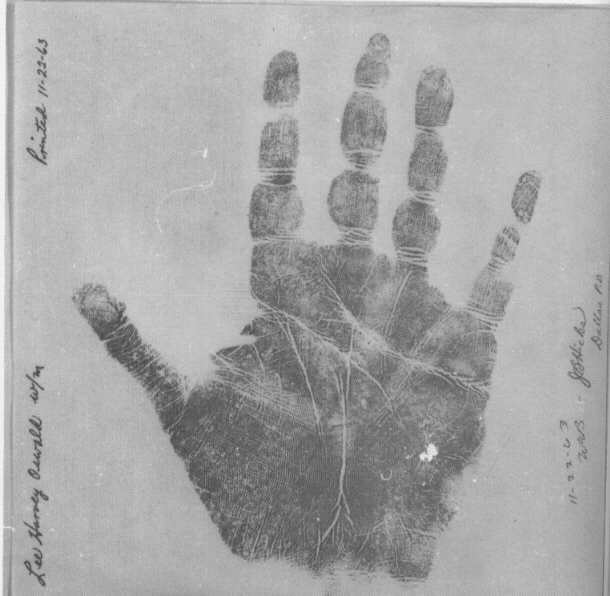
Lee Harvey Oswald’s Palm Prints.
The palm print is of major interest and that is because eventually Oswald’s palm print was linked to the rifle, but before it got to that it went through some interesting moves. I will share all my available information that I have managed to gather and my special thanks go to Malcolm Blunt for some of the documentation, Terry Martin for the scans of the hallway photographs. Also NARA, MFF, AARC and UNT. And additional research by Michael T Griffith, Harold Weisberg, Henry Hurt and David Lifton. Sylvia Meagher is one of the very first ones, in Dec. 1964, who writes about this.
The palm print cards.
There are two sets of Nov. 22nd palm prints known to me. Both signed by Hicks, and referred to as CE 735 & 736. A better quality set is also at the Malcolm Blunt archive in a FBI report from May 19 1978.
Then at UNT, the second set (left & right) is also signed again by Hicks and the images are referred to as the Commission Exhibits. This means that these photos come from the WC and are not reproductions from the DPD themselves. The black edging and numbering give that away. These sets are not originals.
These sets differ from each other once you check the annotations and the positions of the printed fingers of the palm prints in the photographic reproductions.
Carl Day and the Mannlicher-Carcano rifle.
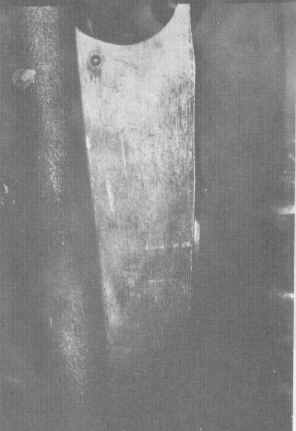
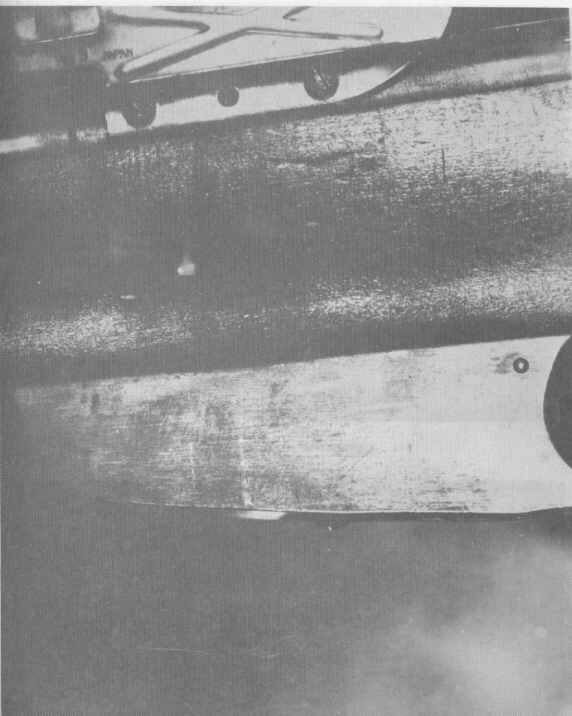
Taking a closer look at Carl Day and his statements about the alleged palm print lift. It was allegedly underneath the barrel and ‘protected’ by the wood stock. Day was the only person who handled the rifle.
Lieutenant Day is seen in this Helmer Reenberg compilation of various clips handling the weapon on the sixth floor of the TSBD, near the front entrance and inside the third floor corridor of the DPD. Below a set of photos of Day in the third floor corridor on his way to Room 317 of Robbery & Homicide which was Will Fritz’s office and where Marina Oswald was to be shown the rifle for identification. She was of no help to them. There are no reports of Marina positively identifying the rifle there and then.
-

- Carl Day. Pic.: Tony Record]

-

- Carl Day. Behind him is Will Fritz to the right and next to Day’s left lower arm is Seth Kantor (with moustache) Pic.: Fort Worth Star Telegram

-

- Carl Day and the Mannlicher Carcano Pic.: Fort Worth Star Telegram

-

- Carl Day inside Robbery & Homicide Room 317. Screengrab BK

-

- Carl Day inside Robbery & Homicide Room 317. Screengrab BK

In his W.C. testimony he explains where he found the print and what happened during the process of developing the palm print.
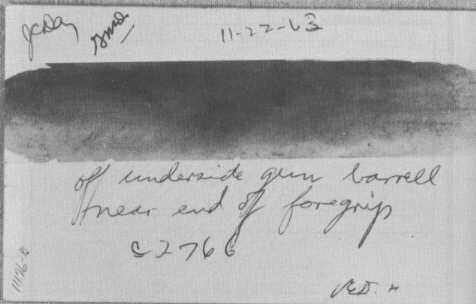
Mr. DAY. I took it to the office and tried to bring out the two prints I had seen on the side of the gun at the bookstore. They still were rather unclear. Due to the roughness of the metal, I photographed them rather than try to lift them. I could also see a trace of a print on the side of the barrel that extended under the woodstock. I started to take the woodstock off and noted traces of a palmprint near the firing end of the barrel about 3 inches under the wood-stock when I took the woodstock loose.
Mr. BELIN. You mean 3 inches from the small end of the woodstock?
Mr. DAY. Right–yes, sir.
Mr. McCLOY. From the firing end of the barrel, you mean the muzzle?
Mr. DAY. The muzzle; yes, sir.
Mr. BELIN. Let me clarify the record. By that you mean you found it on the metal or you mean you found it on the wood?
Mr. DAY. On the metal, after removing the wood.
Mr. BELIN. The wood. You removed the wood, and then underneath the wood is where you found the print?
Mr. DAY. On the bottom side of the barrel which was covered by the wood, I found traces of a palmprint. I dusted these and tried lifting them, the prints, with scotch tape in the usual manner. A faint palmprint came off. I could still see traces of the print under the barrel and was going to try to use photography to bring off or bring out a better print. About this time I received instructions from the chief’s office to go no further with the processing, it was to be released to the FBI for them to complete. I did not process the underside of the barrel under the scopic sight, did not get to this area of the gun.
Mr. BELIN. At what time did these same photographs which are the same as Commission Exhibit 720 and 721 of this print—-
Mr. DAY. About 8 o’clock, somewhere around 8 o’clock, in that neighbourhood.
Mr. BELIN. Of what date?
Mr. DAY. November 22, 1963.
Mr. BELIN. What about the lift which has previously been marked as Commission Exhibit 637?
Mr. DAY. About what?
Mr. BELIN. When did you turn that over to the FBI?
Mr. DAY. I released that to them on November 26, 1963. I did not release this—-
Mr. BELIN. You are referring now—-
Mr. DAY. On November 22.
Mr. BELIN. You are referring to Commission Exhibit 637?
Mr. DAY. Yes.
Mr. BELIN. Is there any particular reason why this was not released on the 22d?
Mr. DAY. The gun was being sent in to them for process of prints. Actually I thought the print on the gun was their best bet, still remained on there, and, too, there was another print, I thought possibly under the wood part up near the trigger housing.
Mr. BELIN. You mean the remaining traces of the powder you had when you got the lift, Exhibit 637, is that what you mean by the lift of the remaining print on the gun?
Mr. DAY. Yes, sir. Actually it was dried ridges on there. There were traces of ridges still on the gun barrel.
Mr. BELIN. Can you tell the circumstances under which you sent Commission Exhibit No. 637 to the FBI?
Mr. DAY. We released certain evidence to the FBI, including the gun, on November 22. It was returned to us on November 24. Then on November 26 we received instructions to send back to the FBI everything that we had.
Mr. BELIN. Did you do that?
Mr. DAY. Yes, sir; and at that time I sent the lift marked—-
Mr. BELIN. 637.
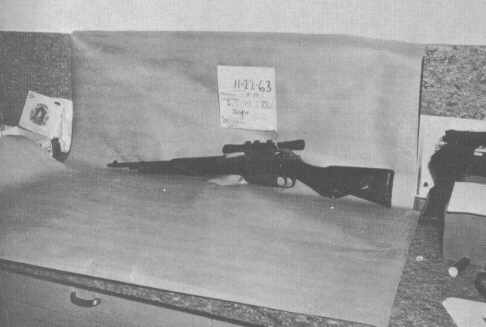
But then Day admits photographing the rifle again. He had another chance to photograph the rifle but did not bother about that all important lift again!
Mr. BELIN. I am now going to hand you No. 737 and ask you to state if you know what this is.
Mr. DAY. Yes, sir. This is the rifle found on the sixth floor of the Texas School Book Depository November 22, 1963.
Mr. BELIN. Who took that picture?
Mr. DAY. I took it myself.
Mr. BELIN. When?
Mr. DAY. About 9 or 9:30 p.m., November 22, on the fourth floor of the City Hall in my office.

Carl Day and the Mannlicher Carcano. Click to enlarge.
Day will not confirm for 100% that Oswald’s palm print is CE 637 without checking it first.
Mr. BELIN. Based on your experience, I will ask you now for a definitive statement as to whether or not you can positively identify the print shown on Commission Commission Exhibit No. 637 as being from the right palm of Lee Harvey Oswald as shown on Commission Exhibit 629?
Mr. DAY. Maybe I shouldn’t absolutely make a positive statement without further checking that. I think it is his, but I would have to sit down and take two glasses to make an additional comparison before I would say absolutely, excluding all possibility, it is. I think it is, but I would have to do some more work on that.
He is questioned about the palm print at the very end by John J McCloy and his statement is very telling.
Mr. McCLOY. Can you restate again for the record what you can positively identify in terms of fingerprints or palm prints and Oswald’s—-
Mr. DAY. The palmprint on the box he apparently sat on I can definitely say it is his without being in fear of any error. The other, I think it is his, but I couldn’t say definitely on a witness stand.
Mr. McCLOY. By the other, you mean the other palmprint?
Mr. DAY. The palmprint and that tracer print aside the trigger housing or the magazine housing.
In an FBI interview from Sept. 9 1964 J.C. Day states on page 4: It appeared probable these prints were from the right palm and fingers of Lee Harvey Oswald, but the rifle was released to the FBI, to be sent to Washington, D .C. before the examination was completed and positive identification of the prints could be made. The prints were not very good for comparison purposes.
Later on he states that after the palm print lift he only told Jessy Curry and Will Fritz about it that evening. He was not able to state the exact time of the discovery nor when he relayed the result to Curry and Fritz. He only knows it is prior Vincent Drain’s collection of the evidence. Yet Curry is asked about the fingerprints that same evening and Will Fritz early on the 23rd and both answered negative.
Hard to believe this as Fritz would have used this there and then since he had nothing that tied Oswald to the rifle at that time. On Dec. 23 1963 Will Fritz has a report made up about the evidence and the palm print is briefly summarised in it. All irregularities are swept under the carpet.

Carl Day and the Mannlicher-Carcano. Click to enlarge.
In Carl Day’s HSCA interview on Oct. 18 1977 he states that Will Fritz ordered him to bring it downstairs and display it to Marina Oswald. Day could not understand whether she recognised the rifle or not. Only after his return to the fourth floor does he ‘discover’ part of a print on the metal bit underneath the barrel where it sits on the stock.
Will Fritz tells him twice to stop as the FBI is taking the rifle with them. No mention of Jesse Curry who was originally stated as the man who told Day to cease his work on the rifle.
He did not give the FBI the print lift as he thought the FBI would do a better job. When the rifle returns to Dallas, Day is disappointed that the FBI did not find the print on the barrel. And once the FBI requires the rifle to be sent back again. Day sent the print lift alongside with the rifle.
He did not make a positive ID with the print he lifted off the barrel as belonging to Oswald. He felt (!) it was Oswald’s, but would not have testified that it was, under oath without further examination.
Henry Hurt for his book Reasonable Doubt interviewed Carl Day and Vince Drain in 1984 (page 109). Day remains adamant that the Oswald print was on the rifle when he first examined it a few hours after the shooting. Moreover, Day stated that when he gave the rifle to Agent Drain, he pointed out to the FBI man both the area where the print could be seen and the fingerprint dust used to bring it out. Lieutenant Day states that he cautioned Drain to be sure the area was not disturbed while the rifle was in transit to the FBI laboratory. Drain flatly disputes this, claiming that Day never showed him such a print. “I just don’t believe there was ever a print,” said Drain. He noted that there was increasing pressure on the Dallas police to build evidence in the case. Asked to explain what might have happened, Agent Drain stated, “All I can figure is that it [Oswald’s print] was some sort of cushion, because they were getting a lot of heat by Sunday night. You could take the print off Oswald’s card and put it on the rifle. Something like that happened.”
In First Day Evidence by Gary Savage & Rusty Livingstone Savage writes Captain Doughty came in at about 20:30 – 21:00 hrs and told Day to stop working on the rifle (p 108).
Also in the book, on page 108, “He then placed a strip of 2” scotch tape over the developed print and rubbed it down before finally lifting the tape containing the print off and placed it on a card. He said he then compared the lift to Oswald’s palm print card and was certain (!) that it was Oswald’s. He also said that after the lift, he could still see an impression of the palm print left on the barrel.
This is hard to believe when Day stated previously stated that he did not do such a thing.
Next, Lieutenant Day had intended to photograph the area of the rifle barrel from which the palm print lift had been made, but was again interrupted by Captain Doughty at about 10:00 pm. He was told once again to stop working on the gun and release it to FBI Agent Drain, who would arrive about 11:30 pm. Lieutenant Day did not have time to write any reports about what he had found, but did have time to reassemble the rifle before Drain arrived.
So we have a third person entering the fold as to teling Day to stop working on the rifle! He is at first told by Will Fritz to cease working on the rifle, then Max Doughty tells him twice at 22:00 and then in a statement made by Day to the FBI (page 5) he said that the call from Jesse Curry to get the evidence ready for the FBI to collect came just before midnight! Curry btw makes no mention of this in any of his WC testimony.
Day said that a few days after the evidence was turned over, an FBI agent came to his house. He wanted too know when Lieutenant Day had lifted the palm print included in the evidence they had received because they had positively identified it themselves as Oswald’s palm print. Lieutenant Day got the impression that they had missed it and he could “envision J Edgar Hoover going into orbit.” (pages 109&110).
Lieutenant Day believed at the time that he had not completely obliterated the palm print on the barrel after his lift and later stated he had pointed out the area of the palm print to FBI agent Drain when turning the rifle over to him. Drain on the other hand did not recall being show the palm print (page 110).
In this ARRB document from Dec. 19 1996 they question the course of the narrative regarding the palm print and the lack of contemporaneous evidence and wonder whether they should question Carl Day again.
Henry Wade.
It is Dallas DA Henry Wade who mentions the alleged palm prints first and that is during the press conference on Nov 24, while Oswald is dead.
The FBI.
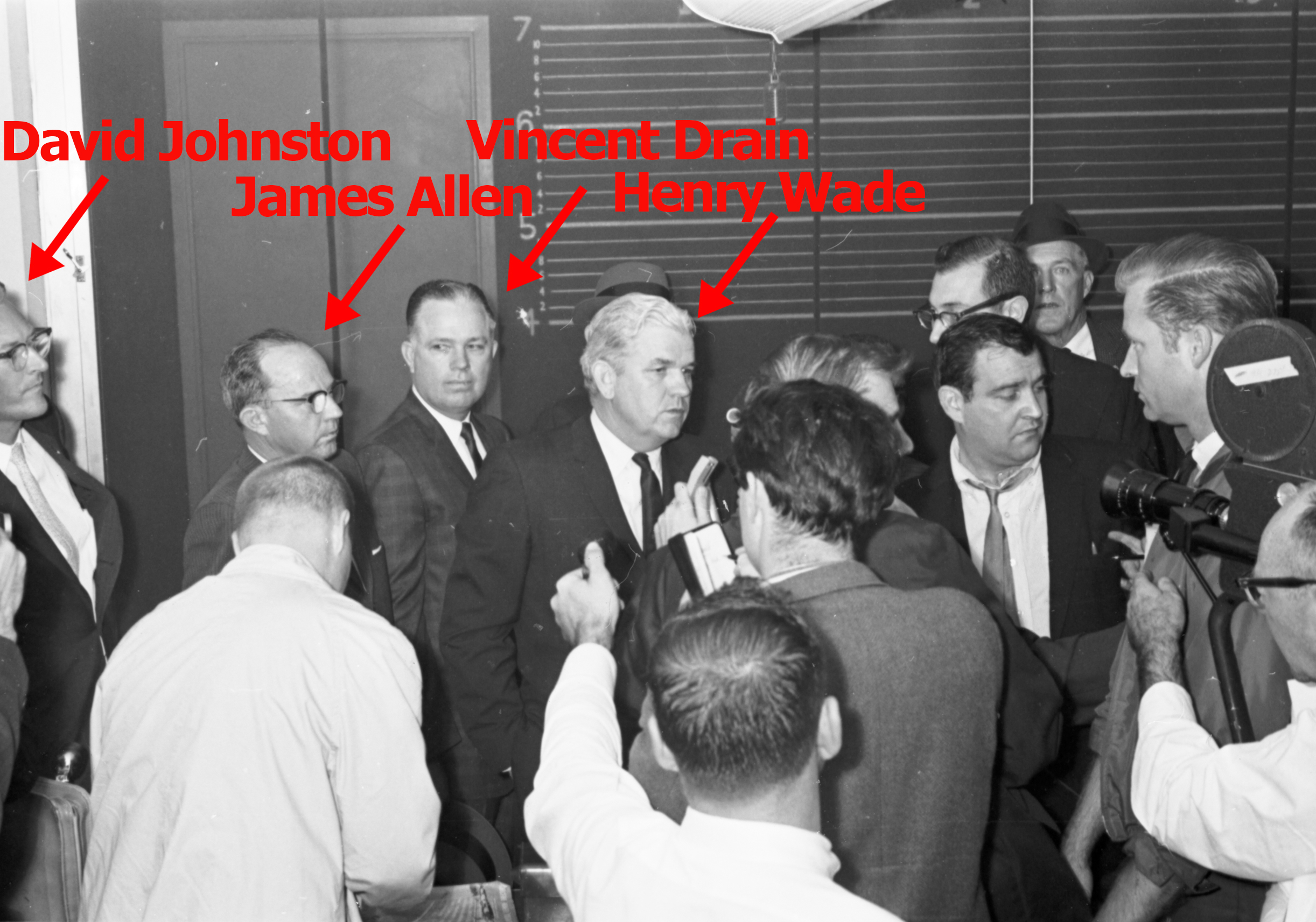
he FBI‘s Vincent Drain collects the rifle. Day and others reports state that he handed the rifle over to Drain at 23:45. This time is hard to accept as being correct. When Oswald speaks to the press at 00:15 he is still wearing his shirt. That shirt was part of the collection of evidence taken by Drain to Washington. Furthermore Henry Wade held a press conference after Oswald’s and Drain is seen standing next to Wade. The earliest Drain could have collected it and taken it away with him would have been 00:30.
The FBI (J Edgar Hoover) writes on Nov. 23rd to DPD Chief Jesse Curry and have found nothing. He states the following on page 7: The latent prints appearing in the photograph taken of the rifle K1, by the Dallas Police Department, are too fragmentary and indistinct to be of any value for identification purposes. Photographs of this weapon taken by this Bureau have failed to produce prints of sufficient legibility for comparison purposes.
After processing the rifle the FBI returns the rifle to the Dallas Police on Nov. 24. The FBI could not find anything, but the DPD produces a palm print lift four days after the evidence has travelled back and forth from Dallas to Washington already.
Then the evidence is turned back over to the FBI by Carl Day to Vincent Drain on Nov. 26th. And this time the palm print lift is included with the rest of the evidence. The official report by Day.
The FBI states in a report, titled “LATENT FINGERPRINTS EXAMINATIONS”, from Nov. 28 that fingerprints and palm prints have been discovered on certain items, but there is no mention of any found on the rifle.
On Nov 29. 1963 the rifle is back in FBI custody after it had been back in DPD custody from Nov 24.
In this report by the ARRB all rifle transporations are logged.
The FBI on Feb. 23 1964 questions the initial missing photographs of the palm print (page 2).
Sebastian Latona.
Sebastian Latona, who is the FBI’s supervisor of the latent fingerprint section of the identity division, in his WC testimony states the following about the quality of the weapon and its connection to fingerprints:
Representative BOGGS. Now, does a weapon lend itself to retaining fingerprints?
Mr. LATONA. This particular weapon here, first of all, in my opinion, the metal is very poorly finished. It is absorbent. Believe it or not, there is a certain amount of absorption into this metal itself. It is not finished in the sense that it is highly polished.
Representative BOGGS. So this would be conducive to getting a good print, or would it?
Mr. LATONA. It would not.
Representative BOGGS. I see-because it would absorb the moisture.
Mr. LATONA. That’s right. Now, there are other guns-for example, Smith and Wesson, which have exceptionally nice finishes, the blue metal finishes are better surfaces for latent prints. Where you have a nickel-plated or silver plated revolvers, where it is smooth-they are much more conducive to latent prints than some of these other things, say like the army type, the weapons used in wartime that are dull, to avoid reflection-things of that type-they are not as good.
Latona has various photographs taken of the rifle and also looks for any other prints.
So I made arrangements to immediately have a photographer come in and see if he could improve on the photographs that were taken by the Dallas Police Department. Well, we spent, between the two of us, setting up the camera, looking at prints,… highlighting, sidelighting, every type of lighting that we could conceivably think of, checking back and forth in the darkroom-we could not improve the condition of these latent prints. So, accordingly, the final conclusion was simply that the latent print on this gun was of no value, the fragments that were there. After that had been determined, I then proceeded to completely process the entire rifle, to see if there were any other prints of any significance or value any prints of value I would not know what the significance would be, but to see if there were any other prints. I completely covered the rifle.
Then he is asked whether he dusted the rifle himself.
Mr. EISENBERG. We will get other evidence in the record at a subsequent time to shon those were the prints of Oswald. Mr. Latona you were saying that you had worked over that rifle by applying a gray powder to it. Did you develop any fingerprints?
Mr. LATONA. I was not successful in developing any prints at all on the weapon. I also had one of the firearms examiners dismantle the weapon and I processed the complete weapon, all parts, everything else. And no latent prints of value were developed.
When it comes to the palm print Latona’s testimony confirms that they had no knowledge of it until seven days after the murder. They only knew of the trigger guard prints wrapped in cellophane. Nor did he see any trace of markings of a lifting on the gun.
Mr. EISENBERG. Now, Mr. Latona, as I understand it, on November 23, ‘therefore, the FBI had not succeeded in making an identification of a fingerprint or palmprint on the rifle, but several days later virtue of the receipt of this lift, which did not come with the weapon originally, the FBI did succeed in identifying a print on Exhibit 1303
Mr. LATONA. That is right.
Mr. EISENBERG. Which may explain any inconsistent or apparently inconsistent statements, which I believe appeared in the press, as to an identification?
Mr. LATONA. We had no personal knowledge of any palmprint having been developed on the rifle. The only prints that we knew of were the fragmentary prints which I previously pointed out had been indicated by the cellophane on the trigger guard. There was no indication on this rifle as to the existence of any other prints. This print which indicates it came from the underside of the gun barrel, evidently the lifting had heen so complete that there was nothing left to show any marking on the gun itself as to the existence of such even an attempt on the part of anyone else to process the rifle.
Mr. DULLES. Do I understand then that if there is a lifting of this kind, that it may obliterate—
Mr. LATONA. Completely.
Mr. DULLES. The original print?
Mr. LATONA. That is right.
Mr. EISENBERG. So that you personally,
Mr. Latona, did not know anything about a print being on the rifle which was identifiable until you received, actually received the lift, Exhibit 637?
Mr. LATONA. On the 29th of November.
Mr. EISENBERG. Seven days after the assassination. And in the intervening period, correspondicgly, the FBI had no such knowledge?
Mr. LATONA. As far as I know.
The WC and the FBI try to iron out the creases.
On Aug 28 1964 Wesley Liebeler reports to J Lee Rankin and mentions the Carl Day’s WC testimony and points out the issues regarding the lift of the palm print. He makes mention of FBI agent Sebastian Latona who makes contradicting statements about the barrel, the fingerprint powder, the prints and the lack thereof.
On Aug 28 1964 in a FBI document to Alan Belmont it is noted that the Warren Commission has some questions about the timing of the actual lift of the palm print. They also wonder aloud whether Day had taken actual photographs of the lift or the barrel and this is something he had not done.
In WC Exhibit 2637, a letter from J Edgar Hoover on Sep 4 1964 to J Lee Rankin. Hoover states that the attached photos of the palm print are the ones that were found under the barrel of the rifle.
In a DOJ document of Sep 11 1964 Day is mentioned as having lifted the palm print and that it belonged to Oswald. And that the FBI also tested it and came to the same conclusion. This record is based on the Sep 9 interview (see previous paragraph) of Carl Day by the FBI.
And when the Warren report is published the whole ‘discovery of the palm print’ is rubber stamped.
Related: Lee Harvey Oswald’s Fingerprints.

Feb
27
Lee Harvey Oswald – Alek James Hidell
While working on my forthcoming paper Anatomy of Lee Harvey Oswald’s Interrogations Vol. 3, which I hope to release in the Autumn of 2021 (more like June 2022!), I came across some documents that made me take a closer look into the find of the Hidell ID and realised something was amiss. This then got me to investigate and trying to figure out how the Alek James Hidell ID came forward during the time that Oswald was incarcerated and interrogated by the DPD until his death. The ‘discovery’ of the Hidell ID on Nov 22 and the significant developments on the 23rd and 24th are this article’s primary focus. And things are not as they are meant to appear at all.
Before I get into the details I suggest you check out Accessories After The Fact by Sylvia Meagher, which to this day, after more than 50 years remains one of the best generic books on the JFK Assassination. In chapter 6 simply titled “Hidell” this matter is already addressed in very good detail. I suggest you read this as it shows how soon after the assassination Sylvia Meagher was close to pointing the many discrepancies on the Hidell matter out. Another good read has been created by Paul Hoch for the Third Decade Magazine who brings in the all important important military intelligence angle, this material was kept far afield from the Warren Commission at that time and only surfaced during the HSCA and also the ARRB investigations. And then there is The Assassination Tapes by George O’Toole. He managed to interview two individuals who were involved with the arrest of Lee Harvey Oswald at the Texas Theatre.
Oswald gets arrested at about 13:50 and is searched while inside the car transporting him towards City Call, where they arrive at about 14:00 or just after. During that journey they radio the DPD dispatch starting at 13:51. A full transcript is on pages 107-110 HERE.
Sergeant Gerald Hill: Suspect of shooting of police officer is apprehended and en route to station.
Dispatch (Hulse and MacDaniel): 10-4. At the Texas Theatre?
Sergeant Gerald Hill: Caught him on the lower floor of the Texas Theatre after a fight.
A little later.
Sergeant Gerald Hill: Patrolman CT walker is in the car with us. Have someone pick up his car at the rear of the Texas Theatre and take it to station. It’s got the keys in it.
Dispatch (Hulse and MacDaniel): 10-4.
And after that another transmission from Gerald Hill to report they were in a special service unit car and giving their location.
Captain C.E. Talbert: You do have the suspect arrested in the Texas Theatre?
Sergeant Gerald Hill: Yes, sir, him and the gun.
This is what is available from the transcript between the car containing Lee Harvey Oswald, a group of 5 DPD officers and detectives and dispatch. I don’t know whether there is anything missing from that transcript but that is all there is. Now then let’s have a closer look at these 5 lawmen and their statements and interviews during that weekend and thereafter.
- Paul Bentley, the DPD detective who sprains his ankle during the scuffle to arrest Oswald inside the Texas Theater speaks to gathered press on the third floor corridor. There is no mention of any Hidell ID.
-

- Paul Bentley DPD – Photo: Jim Murray – Blackstar. Scan by Terry Martin at NARA.

-

- Paul Bentley DPD – Photo: Jim Murray – Blackstar. Scan by Terry Martin at NARA.

-

- Paul Bentley DPD – Photo: Jim Murray – Blackstar. Scan by Terry Martin at NARA.

On the 23rd Bentley is interviewed on WFAA TV and asked about the identification cards he pulled from Oswald’s wallet while they are on their way to City Hall. At 08:39 Paul Bentley explains all this in good detail. Is there any mention of the Hidell ID? Nope.
On Dec 3rd 1963 Paul Bentley writes up his report, rather late if I may add, but even then there is not one mention of a Hidell ID. And that makes it even stranger since the Hidell ID has already come into play by then.
During the first half of the 1970’s, George O’Toole in his book The Assassination Tapes (chapter 9 page 160), manages to interview Paul Bentley, who by that time has moved on from the DPD to work for the First National Bank in Dallas.
Bentley: We had no information hat he was the man who had actually committed the assassination of the president until we radioed in that we had a prisoner and gave the names. And I say names, this was taken from his wallet. he used several different names, as you know. But we gave the names. This was when they told us that he was a suspect in the assassination of the president. So we were instructed to bring him directly to Captain Fritz, who was in the homicide and robbery bureau.
O’Toole: He had the names of both Oswald and Hidell?
Bentley: Right, right.
O’Toole: Both of those identifications?
Bentley: Seems to me like he was using another name, also I can’t remember. I’ve got all this stuff at home. I’m not sure. There were several names that he was using on various cards and then we gave the names to the dispatcher who was instructed to bring them to Captain Fritz.
In a second interview by phone he again asks about the Oswald-Hidell identification (page 163).
O’Toole: Now the identification that he had, though, he had both Hidell and Oswald?
Bentley: Yes, and if I am not mistaken, he had some identification by the other names on him, but I can’t remember offhand what the names were. Seems to me like there were three or four different names that he had in there.
In his first HSCA interview (May 4 1978) Bentley only mentions ‘numerous identifications’
But during a second HSCA interview on June 15 1978 he recalls that he had pulled 5-6 ID cards out of Oswald’s wallet with different names. No mention of Hidell or any other details as to what names they were. A first by Bentley to mention this almost 15 years after the fact!
But it gets better during his Living History talk with the Sixth Floor Museum at 18:08 he even has the nerve to state that Oswald had several aliases. So Mr. Bentley how would you know which name to pick and inform dispatch about this while en route to City hall? There are a few other statements by him during that interview, not context related to this post, that are highly questionable from a truth perspective.
- Kenneth E. Lyon, another Dallas Police Department detective who was part of the arrest team has his report made up on the 3rd of Dec 1963. Again no mention of any Hidell ID.

Kenneth E. Lyon, on the very right, arriving out of the elevator on the 3rd floor with Oswald just behind him. Still grab of CBS footage. Click image to enlarge. Thanks to Denis Morissette for the ID.

Kenneth E Lyon report Dec 4 1963. From History Matters. Click pic to enlarge.
- Bob Carroll, and I am starting to repeat myself here. Not a whiff of any Hidell ID in his Dec 3 1963 statement (pages 41 & 42). Carroll is more known for allegedly taking the gun of Oswald and handing it over to Gerald Hill. he also drove the car that took Oswald and the others to City Hall. Then during Bob Carroll’s Warren Commission testimony the Hidell name is not uttered, but he comes up with something that no other policeman that was in that car did.
Mr. BELIN. Was he ever asked his name?
Mr. CARROLL. Yes, sir; he was asked his name.
Mr. BELIN. Did he give his name?
Mr. CARROLL. He gave, the best I recall, I wasn’t able to look closely, but the best I recall, he gave two names, I think. I don’t recall what the other one was.
Mr. BELIN. Did he give two names? Or did someone in the car read from the identification?
Mr. CARROLL. Someone in the car may have read from the identification. I know two names, the best I recall, were mentioned.
- Another one of the arresting DPD officers is sergeant Gerald Hill. He spoke to the press shortly after as Bentley did and supplied incriminating details, yet not once mentioned the Alek HIdell ID. In a radio interview that same afternoon

Gerald Hill being interviewed inside City Hall. Screen B.K. Click pic to enlarge.
Now Gerald Hill could have forgotten to mention this during that interview, but when he is interviewed for a second time as mentioned In the supplementary volumes of the Warren Report, Hill states to the newsmen, “The only way we found out what his name was, was to remove his billfold and check it ourselves; he wouldn’t even tell us what his name was.” Later in the interview a reporter asks, “What was the name on the billfold?” Hill replies, “Lee H. Oswald, 0-S-W-A-L-D.” No mention at all of the name Hidell. In another filmed interview (at 02:55) Hill makes no mention of the billfold at all. This video is rather poorly edited and looks incomplete.
And then four months later Gerald Hill is being interviewed by the Warren Commission, and by a miracle the Hidell ID appears.
Mr. BELIN. Now after, from the time you started in motion until the time you called in, do you remember anyone saying anything at all in the car?
Mr. HILL The suspect was asked what his name was.
Mr. BELIN. What did he say?
Mr. HILL. He never did answer. He just sat there.
Mr. BELIN. Was he asked where he lived?
Mr. HILL. That was the second question that was asked the suspect, and he didn’t answer it, either.
About the time I got through with the radio transmission, I asked Paul Bentley, “Why don’t you see if he has any identification.”
Paul was sitting sort of sideways in the seat, and with his right hand he reached down and felt of the suspect’s left hip pocket and said, “Yes, he has a billfold,” and took it out.
I never did have the billfold in my possession, but the name Lee Oswald was called out by Bentley from the back seat, and said this identification, I believe, was on the library card.
And he also made the statement that there was some more identification in this other name which I don’t remember, but it was the same name that later came in the paper that he bought the gun under.
Mr. BELIN. Would the name Hidell mean anything? Alek Hidell?
Mr. HILL. That would be similar. I couldn’t say specifically that is what it was, because this was a conversation and I never did see it written down, but that sounds like the name that I heard.
Mr. BELIN. Was this the first time you learned of the name?
Mr. HILL. Yes; it was.
He repeats this years later in an interview with George O’Toole in his book The Assassination Tapes chapter 9, page 157. “As I say, in the car on the way downtown he was belligerent, he was surly, he wouldn’t tell us who he was. We took his billfold out of his pocket, we found the ID in both names, Oswald and Hidell, that he later was proved to have ordered the gun under. He had library cards and drafty cards in one name, and he had identification cards from various organizations in the other name.”
- Charles Truman Walker was present as well during Oswald’s arrest. His official report, from Dec 2 1963, regarding the Oswald arrest does not mention anything about inside the unmarked squad car during the ride towards City Hall. Then it becomes interesting, during Charles Truman Walker’s HSCA interview (page 5) he takes credit for taking the bill fold out of Oswald’s pants pocket, after dropping him off at City Hall. Something Paul Bentley did in the car already! And he makes mention of the Hidell ID and also mentions that he searched Oswald again.
- Gus Rose and Richard Stovall ‘deal’ with Oswald next. They arrive at City Hall just before Oswald is brought in and talk with him for about 10-15 minutes after which Will Fritz arrives and sends them to go to Irving. In the joint report by Richard Stovall, Gus Rose and John Adamcik there is only the briefest mention of this ‘interrogation’. Not a word in that statement on an ID carrying the name Hidell. You’d think something like that would be reported no?
Months later on April 8 1964 Richard Stovall’s W.C. testimony mentions the following before he is sent out by Fritz.
Mr. BALL. Do you remember what was said to him and what he said to you?
Mr. STOVALL. I don’t recall exactly–I went in and asked him for his identification, asked him who he was and he said his name was Lee Oswald, as well as I remember. Rose and I were both in there at the time. He had his billfold and in it he had the identification of “A. Hidell,” which was on a selective service card, as well as I remember.
Mr. BALL. That’s [spelling] H-i-d-e-l-l, isn’t it?.
Mr. STOVALL. I’m not positive on that–I believe it was [spelling] H-i-d-e-l-l, I’m not sure. And he also had identification of Lee Harvey Oswald, and I believe that was on a Social Security card and at that time Captain Fritz opened the door to the office there and sent Rose and I to go out to this address in Irving at 2515 West Fifth Street in Irving.
And later during the same testimony.
Mr. BALL. Now, did you do anything else on this investigation?
Mr. STOVALL. No, sir; that’s all I can recall that I did on the investigation. I might add, there was–well, you have that on the list–some property.
Mr. BALL. What is that?
Mr. STOVALL. When we took this identification off of Lee Oswald that had this selective service card, the name Hidell, and he also had his own identification–at the time we were in the garage we found some negatives out there that appeared that he had make a snapshot of a selective service card, and on the back of the negatives it was where the name would have been typed in–there was some stuff on the back of the negatives to block out the name when it was reprinted, and there were some selective service cards that he had printed himself out there from a negative that were blank and which appeared to be the same that he had on him at the time, on the 22nd of November, that had the name of “A. Hidell” typed in on it.
From the handwritten list (made by two individuals) of the evidence taken from Ruth Paine’s house, and unless these negatives were inside the brown box, 13th entry on the first page, then there is no direct link to these so called negatives at all. Again I will apply the benefit of doubt on this one.
A closer look at the University of Texas JFK Collection which stores the DPD evidence on Lee Harvey Oswald has five pictures with negatives on display. It has hard to look at the details, but Negatives, Photographs #2 seems to display a Selective Services card. The issue is that the resolution is too low to actually see anything to be able to ID and conclude what Stovall is attesting to. Nor is there a photograph of the backside of that negative to see the masking of said negative. I tried to enhance and invert the #2 image. But I have not become any the wiser.

Negatives #2 from UNT. Enhancement by B.K. Click pic to enlarge.
- Gus Rose who has submitted his findings in the same report mentioned just above with Richard Stovall and John Adamcik. These three also release a supplemental report and even then not a peep on any negatives or the Hidell ID. The handwritten report by Gus Rose (I assume it was him since it is the first name of the three at the bottom of this doc) does not help either.

Gus Rose behind Buell Wesley Frazier late on Nov 22 1963. Photo: Jim Murray – Blackstar. Scan by Terry Martin at NARA. Click pic to enlarge.
- Gus Rose’s WC. testimony states:
Mr. ROSE. There were some people in the office from the Book Depository and we talked to a few of them and then in just a few minutes they brought in Lee Oswald and I talked to him for a few minutes?
Mr. BALL. What did you say to him or did he say to you?
Mr. ROSE. Well, the first thing I asked him was what his name was and he told me it was Hidell.
Mr. BALL. Did he tell you it was Hidell?
Mr. ROSE. Yes; he did.
Mr. BALL. He didn’t tell you it was Oswald?
Mr. ROSE. No; he didn’t, not right then–he did later. In a minute–I found two cards–I found a card that said “A. Hidell.” And I found another card that said “Lee Oswald” on it, and I asked him which of the two was his correct name. He wouldn’t tell me at the time, he just said, “You find out.” And then in just a few minutes Captain Fritz came in and he told me to get two men and go to Irving and search his house.
Mr. BALL. Now, when he first came in there–you said that he said his name was “Hidell”?
Mr. ROSE. Yes.
Mr. BALL. Was that before you saw the two cards?
Mr. ROSE. Yes; it was.
Mr. BALL. Did he give you his first name?
Mr. ROSE. He just said “Hidell”; I remember he just gave me the last name of “Hidell”.
Mr. BALL. And then you found two or three cards on him?
Mr. ROSE. Yes; we did.
Mr. BALL. Did you search him?
Mr. ROSE. He had already been searched and someone had his billfold. I don’t know whether it was the patrolman who brought him in that had it or not.
Mr. BALL. And the contents of the billfold supposedly were before you?
Mr. ROSE. Yes.
And from this short interview session with Oswald on the 22nd in their Warren Commission testimonies it becomes apparent that Rose and Stovall contradict each other about Lee Harvey Oswald telling them what his name was.. Yet they were inside the same room. They make mention of the Selective Service Car found on Oswald only during their W.C. testimony.
In 1998 in an article from DMagazine Gus Rose mentions the card again. On the table lay the two identification cards. Rose looked down at them. One read “Alec Hiddel.” The other: “Lee Oswald.”
In which case it would be easy to spot for the people involved with interrogating Lee Harvey Oswald shortly after, no?
- Will Fritz starts to interrogate Oswald, first by himself, backed up by Elmer Boyd and Richard Sims, starting at about 14:30 inside room 317 of Robbery & Homicide. Gus Rose and Richard Stovall could have mentioned the Hidell ID, but they failed telling him. Fritz does not mention anything about the ID during this first interrogation lasting an hour and a half until 16:00..
- James P Hosty and James W Bookhout join Fritz about 45 minutes later at about 15:15. In those 90 minutes again the Hidell ID is not brought up once by either FBI agent at any time during this first interrogation. It is not found in Fritz’s interrogation notes and his subsequent report, Hosty’s handwritten interrogation notes and the joint Bookhout and Hosty FBI report. And yet they do bring up the O.H. Lee name which is the name accredited to Oswald using it at his North Beckley residence. Which from a timing p.o.v. and compared to the Hidell name is remarkable.

James W Bookhout (in a light colored suit wearing glasses and smoking a pipe) inside Robbery & Homicide. Photo by Jim Murray. Scan by: Terry Martin at NARA. Click pic to enlarge.
During James Bookhout’s W.C. testimony the Hidell name gets brief mentions, but only in the vaguest terms.
Mr. STERN – What sort of question would he refuse to answer? Was there any pattern to his refusing?
Mr. BOOKHOUT – Well, now, I am not certain whether this would apply then to this particular interview, the first interview or not, in answering this, but I recall specifically one of the interviews asking him about the Selective Service card which he had in the name of Hidell, and he admitted that he was carrying the card, but that he would not admit that he wrote the signature of Hidell on the card, and at that point stated that he refused to discuss the matter further. I think generally you might say anytime that you asked a question that would be pertinent to the investigation, that would be the type of question he would refuse to discuss.
And later during the same testimony when they do discuss the first interrogation of the 23rd.
Mr. STERN – Did you ask any questions in the course of this interview?
Mr. BOOKHOUT – Yes.
Mr. STERN – What were they, and what were the responses, if you recall?
Mr. BOOKHOUT – One specific question was with regard to the selective service card in the possession of Oswald bearing a photograph of Oswald and the name Alek James Hidell. Oswald admitted he carried this selective service card, but declined to state that he wrote the signature of Alek J. Hidell appearing on same. Further declined to state the purpose of carrying same, and—or any use he made of same.
- Robert E Jones of the 112th INTC contacts the DOJ at 15:15 while Oswald is being interrogated by Will Fritz and in this document Oswald is already marked as the guilty man for the Tippit murder. Jones provides of plenty information on Lee Harvey Oswald and his previous endeavors in Russia and New Orleans, the majority coming from newspaper clippings. The timing and the sharing of this is most interesting when Oswald is still being interrogated and Hosty and Bookhout have only just walked in. But the hammer of course is that Jones already knows that Oswald was carrying a Selective Service Card bearing the name of A.J. Hidell. This is quite remarkable as well when not one of the arresting officers attested to having found this card that day. Not until months later! Following this report we get a report by the Secret Service on Dec 5 1963 which tries to clarify that the Ana J Hidell is a typo. As much as I want to believe that correction I also know that the Secret Service messed around a lot in their reporting with TSBD workers i/e in early Dec of 1963. But let’s give ’em the benefit of doubt in this instance.
The HSCA investigates and interviews Jones on 3 occasions over the period of a year.
The first time on April 4 1977. The following document is Robert Jones’ HSCA interview from April 20 1978. This session is filled with some good details. In a nutshell Jones got his information from someone inside the D.P.D. at about 13:30-14:00 and that poses quite an issue, since no DPD officer is on record at that time about the Hidell ID or name at that time. Better yet Oswald was arrested at 13:50 after the vaguest description possible was sent through DPD dispatch. Compare that to the one sent out for Charles Douglas Givens just before the DPD entered the Texas Theater.
- Forrest Sorrells gets about ten minutes to talk to Oswald before he is taken down for his first line-up with Helen Markham. Not a word about Hidell.
- Then at 16:25 the San Antonio bureau of the FBI sends a report to its director and to the Dallas office. Again Oswald is declared the guilty man for murdering Tippit. Which is remarkable as well since the timing of the cable is ten minutes before Oswald’s first line-up with the hysterical Helen Markham.

FBI Report 16:25 Nov 22 1963. Click to enlarge

- Jim Hosty, later that day and not allowed to be present during the interrogations anymore hangs about Robbery & Homicide Bureau and takes notes of the so called Oswald evidence which is laid out on a table.

James P Hosty (newspaper to his side) speaking to Bill Alexander inside Robbery & Homicide. Photo by Jim Murray. Scan by: Terry Martin at NARA. Click pic to enlarge.
In the photograph above you can see the office with the blinds on the right which is where Oswald was interrogated. The glass window on the left behind Bill Alexander was Walter Potts office where the evidence was laid out.
In Assignment Oswald Hosty states “I decided nonetheless that I would remain at the police station. Just because I couldn’t talk to the police didn’t mean I couldn’t learn things from them. I headed back to Fritz’s office, where I knew the police were keeping Oswald’s personal belongings. Nothing there, but in the second inner office, which belonged to Lieutenant Walter Potts, I spotted Oswald’s things, which had been removed from his person and from his apartment at the Oak Cliff rooming house.” Hosty then starts mentioning Oswald’s address book and the entry of his name in it. Anything about Hidell then? Ehm……no! Keep this in mind when it is Manning Clements’ turn to go through the same evidence not much later.
Then there is the Church Committee testimony that Hosty gave on Dec 13th 1975. On page 138 he mentions the same as above that he goes into the adjoining office and goes through the evidence. And again the direction moves immediately towards the address book. No mention of a Hidell ID. Hosty would have mentioned that if there was one.
- Manning Clements arrives in the evening of Nov 22nd and sees James Bookhout, and asks him if anyone has, to his knowledge, taken a detailed physical description and background information from Lee Harvey Oswald. Bookhout tells him that such description and background data had not been obtained, and suggests that Clements do it. In his Warren Commission testimony Clements says that he questioned Oswald at about 10 PM, but this is wrong. Thanks to a report by M.G. Hall, who is very precise with his timings. he makes mention of Clements’ arrival at 19:40. Which is very close to the “I’m just a patsy” scene in the corridor. Clements talks with Oswald over a period of just about half an hour, and his questioning the suspect gets interrupted during which time Oswald is taken out for a line-up, which would be the one with the Davis Sisters. While Oswald is gone Clements has a look at the evidence and he, allegedly, sees the Selective Services card with the Alek James Hidell name on it. In his report made the next day on the 23rd he is the first person that makes an actual mention of seeing the Hidell Selective Services card the day before yet he does not make no mention of any other item from Oswald’s wallet. What boggles the mind even more is that he makes no mention of this ‘fact’ to James Bookhout or Will Fritz who start their third interrogation at 19:55!
- This FBI report from its director is made up at 10:21 PM on the 22nd of Nov. and it deals predominately about the Hidell link to the FPCC.

FBI report 10:21 PM Nov 22 1963. Click pic to enlarge.
- Don Stringfellow of the DPD Crime Intelligence Division sends a cable to the 112th INTC that Oswald is a card carrying communist. Robert E Jones of the 112th INTC has his thoughts about this during a HSCA interview on Dec 28 1978.
- On Nov 23rd, near the end of the first interrogation just before 11:30 Will Fritz mentions in his notes that FBI agent James Bookhout asks him about the Hidell ID. This handwritten note is the first trace of anyone of the D.P.D. actually asking Oswald about this. James Bookhout and Thomas J Kelley mention this at the end of their reports as well. This is after the mail order for the rifle has been discovered in Chicago earlier that morning. Come on…this is just ‘sheer coincidence’.
-

- Hidell ID – Will Fritz handwritten notes.

-

- Hidell ID – James Bookhout

-

- Hidell ID – Thomas J Kelley

- On the morning of the 24th Harry Dean Holmes has joined Will Fritz, Jim Leavelle, Forrest Sorrels for a last interrogation before Oswald is to be transported to the Dallas jail. Holmes writes in a report in which he stated that Fritz asked Oswald about the Hidell I.D. card, and Oswald “flared up and stated ‘I’ve told you all I’m going to about that card. “You took notes, just read them for yourself, if you want to refresh your memory” Oswald could have been referring to anyone in that room.
In Harry Dean Holmes’ W.C. testimony he states:
Mr. HOLMES. In his billfold the police had found a draft registration card in the name of A. J. Hidell on his person at the time of his arrest, and I had seen it.
And later on during the same testimony session Harry Dean Holmes brings up the ID again..
“Well, who is A. J. Hidell?” I asked him.
And he said, “I don’t know any such person.”
I showed him the box rental application for the post office box in New Orleans and I read from it. I said, “Here this shows as being able to receive, being entitled to receive mail is Marina Oswald.” And he said, “Well, that is my wife, so what?”
And I said also it says “A. J. Hidell.”
“Well, I don’t know anything about that.”
That is all he would say about it.
Then Captain Fritz interrupted and said, “Well, what about this card we got out of your billfold? This draft registration card, he called it, where it showed A. J. Hidell.”
“Well, that is the only time that I recall he kind of flared up and he said, “Now, I have told you all I am going to tell you about that card in my billfold.” He said, “You have the card yourself, and you know as much about it as I do.” And he showed a little anger. Really the only time that he flared up.
- Walter E Potts’ report states that he had gone to the Beckley address on the 22nd and claims that they checked for the Oswald and Hidell names and then find out that Oswald was registered under the name O. H Lee. The issue with this report is that it is made after the 25th.
- In Will Fritz interrogation report of which there are half a dozen different versions available and which he wanted amended before it was sent of to the Warren Commission, he makes a brief entry about the Hidell ID.

Will Fritz – Interrogation of Lee Harvey Oswald. From: UNT. Click pic to enlarge.
So let’s recap!
There is no report from the DPD on the 22nd of Nov that points to the Hidell name and ID at all. Anyone from that group interviewed by the press makes no mention of this either.
Robert Jones of the 112th INTC was informed by someone of the DPD, name not remembered during his HSCA testimony, early that afternoon of the 22nd about Oswald and the Hidell ID
The FBI claims that Jones rang them and gave them the news after which they shared this with other bureaus.
The Hidell name is not brought up by anyone at all on Nov 22nd even though some law enforcement officers claim they saw the ID, yet when they had the opportunity to question Oswald about this ID it did not happen. This includes Will Fritz, James Bookhout, James Hosty and Manning Clements.
The first real evidence that Oswald was asked about the Hidell name is at the end of the first interrogation close to 11:30 on Nov 23rd 1963. This is confirmed by reports of Will Fritz, James W Bookhout and Thomas J Kelley.
Shortly before, in Chicago, an order for the alleged murder weapon, a Mannlicher-Carcano in the name of Alek J Hidell is found and reported to the FBI.
On Nov 23 1963 Richard Sims of the DPD submits the wallet contents to the Identification Bureau and requests 4 copies of photographs of each item. The description of them is very generic.
On Nov 29 1963 the FBI creates a report of the wallet contents sent from the DPD to the FBI, is there a mention of the Hidell Selective Service Card? Nope. On top of that according the Feds it appears the DPD had failed to photograph this content and requests the FBI to do so…….
In a document dated Dec 19th 1963 the FBI states that it had received Oswald’s wallet and that it did not contain the US Marines Certificate of Service and the Selective Service Card in the name of Hidell. And that these were subsequently sent as such at a later date. And that the SSC was a complete forgery.
This FBI document from Nov 23 1963 is also not online anywhere else. I have highlighted the Hidell related matters. This document provides a good insight that the Hidell name and rifle order came not in play until Saturday morning the 23rd.
______________________________________________________________________________________________________________
With thanks to:
Malcolm Blunt for a lot of documents.
Harold Weisberg Archive at Hood College.
UNT.
Ⓒ Bart Kamp